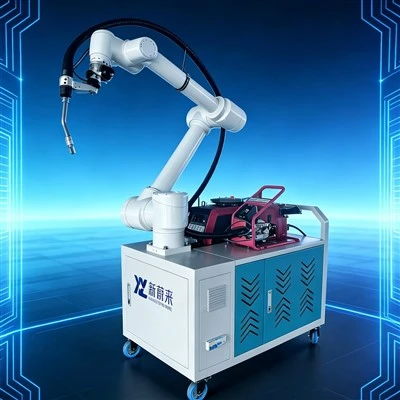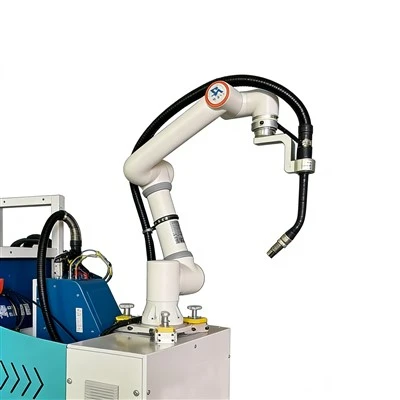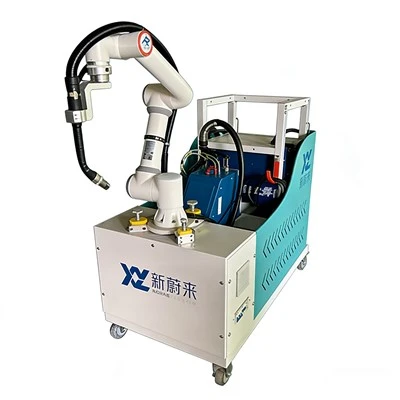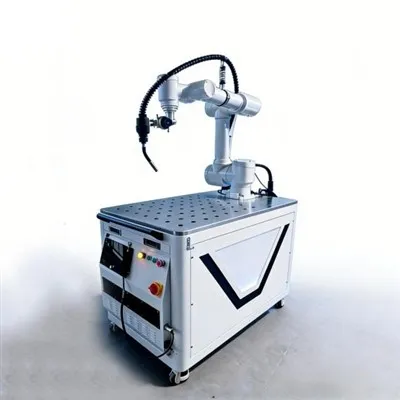


Product Structure
The complete unit consists of five core assemblies: a multi-axis linkage robotic arm, built-in motion controller, dedicated welding execution unit, safety sensing module and interactive teach pendant. All assemblies adopt an integrated layout with internally routed pipelines to avoid external tangling. The outer casing is constructed from high-strength protective material, balancing structural rigidity with convenient daily maintenance to adapt to complex industrial workshop environments.
Products Description
The 1600 Arm Reach Welding Robot features a 1600 mm effective working radius and a standard payload of 20 kg, compatible with mainstream welding torches and wire feeding assemblies. It adopts a compact, lightweight body with a hollow wrist for internal cable routing to prevent cable tangling during movement, and achieves a repeat positioning accuracy of ±0.04 mm for smooth, steady motion trajectories. It supports floor-mounted, wall-mounted and inverted installation configurations, with an IP56 protection rating to withstand welding fumes and molten metal spatter. Equipped with a dedicated welding control system, it supports direct teach programming, offline programming and arc tracking for arc welding of small and medium components including vehicle frames, hardware parts and construction machinery fittings. Multi-axis high-speed linkage shortens production cycle times. Operable within an ambient temperature range of 0–55°C, it runs stably 24 hours a day with simple commissioning and maintenance. It fully covers processing demands for small and medium workpieces while fitting narrow workshop stations, and is widely deployed on automated welding lines for steel structures, agricultural machinery and automotive spare parts.

Application Scope
Automotive Spare Parts
Suitable for welding small and medium automotive structural components, covering processing requirements for chassis fittings and small body panels.
01
Hardware Manufacturing
Supports mass welding of various hardware components, applicable to production processes for fitness equipment, sheet metal and general hardware products.
02
Construction Machinery
Designed for welding small construction machinery fittings, ensuring weld strength and surface forming of thick workpieces meet industrial standards.
03
Metal Furniture
Performs continuous welding for metal furniture frames, producing smooth, aesthetic weld beads and reducing subsequent polishing workload.
04
General Manufacturing
Covers a wide range of small-to-medium batch metal processing scenarios, enabling small and medium manufacturers to rapidly implement automated welding upgrades.
05
Functional Features
Manual drag-and-teach functionality directly records welding trajectories. Operators with zero professional programming experience can quickly complete programming for new workpieces.
Built-in flexible collision detection triggers an immediate automatic shutdown upon contact with obstacles, preventing accidental damage to equipment and workpieces.
Automatically locates workpiece joint lines to accommodate minor clamping offsets and lower precision requirements for tooling fixtures.
FAQ
Q: Is this robotic welding system difficult to learn and operate?
A: The operating logic is fully streamlined with an intuitive human-machine interface. General factory operators can independently complete basic welding tasks after a short hands-on training session without advanced automation programming expertise, delivering a gentle learning curve.
Q: Does the equipment produce loud noise during daily operation?
A: The 1600 Arm Reach Welding Robot features optimized noise suppression, keeping operating sound within acceptable industrial limits. No harsh roaring occurs during standard welding cycles, and prolonged nearby operation will not create noticeable acoustic discomfort, making it suitable for regular workshop environments.
Q: Are there potential safety risks between operators and the robot during operation?
A: It supports human-robot collaborative operation and requires no isolated safety fencing. Operators can stand adjacent to the robot to place workpieces and assist positioning simultaneously. The unit halts immediately upon physical contact with personnel, guaranteeing safety during collaborative workflows.
Q: Are daily cleaning and maintenance procedures complicated after long-term use?
A: The machine's outer shell features a smooth, streamlined design without hard-to-reach gaps or dead corners. Basic daily maintenance only requires simple wiping and compressed air blowing, making routine upkeep quick and effortless.
Market Outlook
Small and medium-sized manufacturers show sustained growing demand for automated welding upgrades. The 1600 Arm Reach Welding Robot perfectly matches flexible production workflows for small and medium workpieces, and the shift from manual welding to robotic welding continues to accelerate. As manufacturing evolves toward multi-variety, small-batch production, flexibly deployable, low-learning-threshold robotic welding equipment will gain rapid adoption across hardware, auto parts and numerous other sub-industries, supporting broad long-term market growth potential.