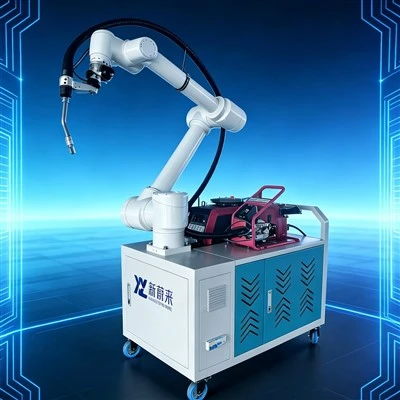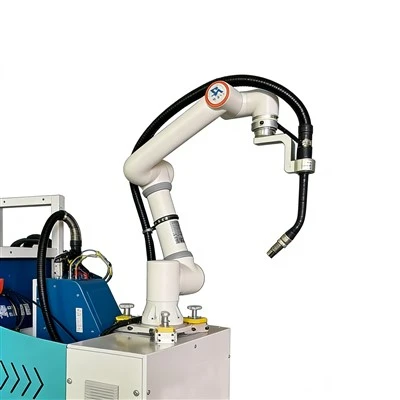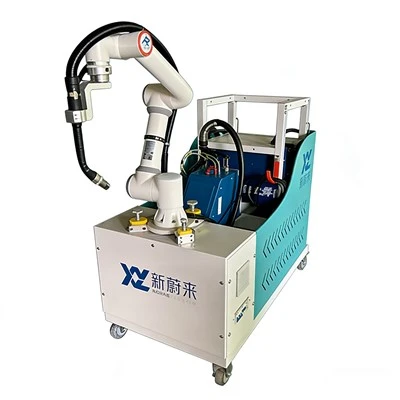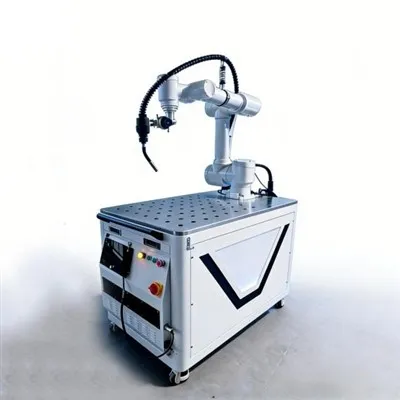


Product Philosophy
Built around the core design concept of human‑robot collaboration, the collaborative robot requires no traditional safety isolation fences and works alongside operators to complete welding operations within the same workspace.
Product Advantages

Flexible Deployment
Boasting a compact and lightweight structure, it requires no extensive site modification and can be rapidly relocated and deployed across different workstations.
Human‑Robot Collaboration
No traditional safety guarding fences are required. Operators and the robot can complete welding tasks jointly within the same working area.
Consistent Precision
Smooth, accurate trajectory control during welding generates well‑formed, uniform weld seams, drastically cutting extra workload for subsequent grinding and re‑welding.
Simple Operation
It is equipped with a visual intuitive operating system. Regular welding operators can master programming and operation after short‑term training.
Strong Compatibility
It connects with various mainstream welding‑process equipment and can integrate into existing production lines without major modifications.
Application Scope
Hardware Manufacturing: Suitable for batch welding of various hardware components and metal spare parts. It improves efficiency and part consistency for small‑component welding.
Equipment Manufacturing: It performs structural‑part welding for engineering machinery and general‑purpose equipment and ensures stable weld quality for medium‑to‑large components.
Automotive Components: It supports welding production for auto spare parts and meets flexible‑production requirements for high‑mix, small‑batch components.
Sheet‑metal Processing: It carries out continuous welding for sheet‑metal cabinets and metal enclosures and reduces welding deformation of sheet‑metal workpieces.
Steel‑structure Parts: It adapts to welding‑processing scenarios for light‑duty steel‑structure components and flexibly switches production among workpieces of different specifications.
Operating Instructions
Pre‑start Inspection
Before startup, inspect the welding torch, wire‑feed mechanism and all connecting cables. Confirm there is no looseness or jamming before activating the equipment.
Teaching Programming
Record welding paths using hand‑guided teaching. Preview trajectories and confirm their correctness before launching automatic welding cycles.
Test‑weld Verification
Conduct test welding on the first sample before mass production. Confirm acceptable weld quality prior to continuous batch‑mode operation.
Daily Maintenance
At the end of each work shift, promptly remove welding spatter and smoke residues adhering to the torch and robot body to keep the equipment clean.
Product Precautions
Standardized Teaching
Pay close attention to the robot's motion range during teaching programming to avoid hard collisions between the robotic arm and surrounding fixed equipment.
01
Fume Control
Equip the working zone with welding‑fume‑extraction devices. Prevent heavy fume accumulation on machine surfaces, as it will shorten component service life.
02
Parameter Restriction
Non‑professional personnel shall not alter core motion parameters privately, so as to eliminate safety risks caused by uncontrolled movements.
03
Environmental Requirements
Install the equipment away from strongly corrosive sources and heavy‑vibration locations to sustain long‑term running stability and positioning accuracy.
04
Periodic Calibration
Calibrate welding accuracy at regular intervals to avoid trajectory drift after prolonged operation.
05
Why Choose Us
We possess in‑depth expertise in industrial welding automation. We understand production pain points across diverse welding scenarios and deliver proven, practical adaptive solutions.
A full‑process production quality management system is implemented. Every unit undergoes multiple rounds of testing under real‑world welding conditions before factory release.
Our dedicated industrial‑service engineers respond quickly to customer requests and resolve commissioning and operational issues efficiently.
Equipment configurations can be adjusted according to customer workpiece specifications and welding‑process requirements to meet demands of special‑production scenarios.
Comprehensive supporting services cover preliminary‑process selection, on‑site installation and commissioning, enabling fast equipment commissioning and production launch.
FAQ
Q: What should I do when weld seam offset occurs on Welding Collaborative Robot?
A: First check whether workpiece clamping is secure. Fine‑tune the taught trajectory or activate the vision‑tracking function to correct deviations.
Q:How to improve insufficient teaching accuracy?
A: Perform steady hand‑guided teaching. Fine‑tune waypoints repeatedly and save trajectories to enhance path‑control precision.
Factory Environment


Hot Tags: welding collaborative robot, China welding collaborative robot manufacturers, suppliers, factory, collaborative robot vision system, collaborative robotic welding handling, collaborative weld assembly, collaborative welding cobot, collaborative welding robot ai vision, collaborative welding robot smart manufacturing