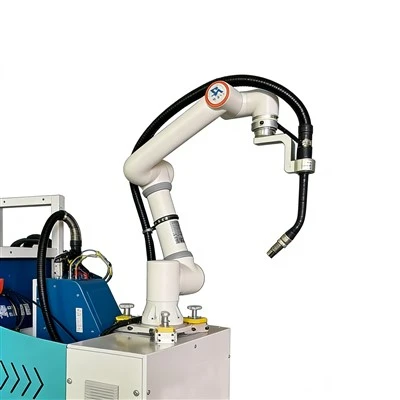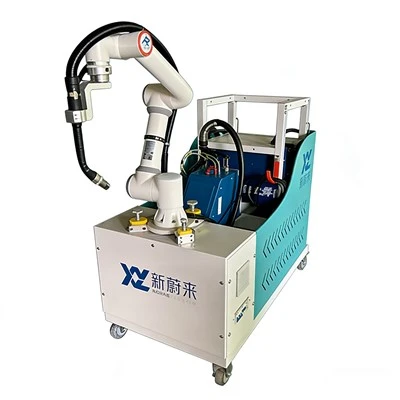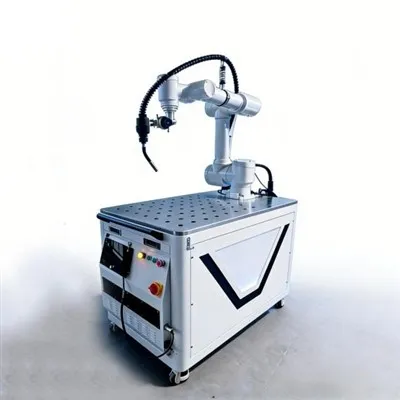


Products Description
Developed for specialized welding workflows, the 1600 Arm Span Collaborative Welding Robot is a flexible industrial solution for automated welding of diverse small and medium workpieces. It features a compact, agile body with a 20 kg payload and integrates seamlessly with existing workshop production lines without complex safety fencing. It replaces repetitive, harsh manual welding processes, operates within an ambient temperature range of 0–55°C, and consumes a maximum of only 3.5 kW power. Balancing high welding precision and stable performance, it reduces manufacturers' reliance on highly skilled welders and caters to flexible multi-variety, small-batch production requirements.
Product Advantages
Flexible Deployment
With a maximum working radius of 1600 mm and a compact footprint, it supports fast on-site installation and commissioning without large-scale modifications to existing workshop layouts.
01
Powerful Collaborative Functionality
With a 20 kg payload capacity, it collaborates with operators within the same workstation without fully enclosed safety fences, ideal for flexible production line layouts.
02
Consistent Precision
It delivers ±0.04 mm repeat positioning accuracy and maintains identical welding trajectories throughout production, eliminating inconsistent workmanship inherent to manual welding and ensuring uniform finished weld quality.
03
Broad Compatibility
Compatible with multiple mainstream welding processes to accommodate workpieces of various materials. Welding power sources from brands including Aotai and Panasonic are available as optional accessories to fit diverse production scenarios.
04
Cost Reduction & Efficiency Boost
It supports extended uninterrupted stable operation, drastically reducing manual labor intensity and extending effective daily production hours.
05
Working Principle
Powered by its built-in motion control system, the 1600 Arm Span Collaborative Welding Robot reads pre-programmed welding trajectory paths and drives the welding torch to precise positioning via multi-axis coordinated movement. It synchronizes wire feed speed and welding current parameters with the welding power source, maintaining steady torch angles to form uniform, continuous weld beads along workpiece joints.
Process Technology
Smooth Trajectory Calibration
Advanced smooth motion trajectory algorithms deliver seamless torch movement without stalling, eliminating arc jumping and broken weld defects during production.
Anti-electromagnetic Interference Design
Key core components are optimized for anti-interference performance, maintaining stable, error-free operation in complex industrial electromagnetic environments.

Synchronized Collaborative Control
Real-time linkage between mechanical movement and welding parameters automatically adjusts current and wire feed speed to match dynamic working conditions as the torch moves.
Integrated Internal Pipeline Layout
All cables and fluid pipelines are routed internally to reduce abrasion and external tangling, significantly extending the overall service life of wiring and tubing assemblies.
Maintenance Guidelines
Regular Dust Removal
Periodically clear accumulated dust inside the robot body and control cabinet using dry compressed air to avoid heat dissipation failures caused by dust buildup.
Routine Pipeline Inspection
Inspect internal pipelines regularly for abrasion; replace or repair components showing early aging signs promptly to prevent malfunctions from pipeline rupture.
Scheduled Joint Lubrication
Replenish specialized lubricating grease to robotic arm motion joints on a fixed cycle to ensure smooth joint movement without stalling or abnormal noise.
Periodic Precision Recalibration
Verify the unit's repeat positioning accuracy at set intervals, and recalibrate to restore factory precision if minor deviations are detected.
FAQ
Q: Will the robot stall during long hours of non-stop continuous welding?
A: Its optimized internal heat dissipation structure supports prolonged uninterrupted welding cycles. Stable mass production operation rarely encounters stalling or overheat shutdowns, making it suitable for daily batch workshop production workflows.
Q: How consistent is the weld bead appearance of workpieces processed by the 1600 Arm Span Collaborative Welding Robot?
A: Welding movements remain stable and continuous throughout operation, forming neat, even weld lines free of uneven width or bumpy surfaces, delivering highly consistent visual quality across all finished welded parts.
Q: Is switching processing modes complicated when welding workpieces of different materials?
A: Material switching operations are straightforward; only corresponding operating mode adjustments are required without complex parameter reconfiguration, enabling seamless transitions between different workpiece materials.
Q: Will heavy welding dust and fumes in the workshop interfere with normal robot operation?
A: All key machine components feature dedicated dustproof protective treatment. Standard levels of welding fume and dust found in regular welding workshops will not disrupt stable equipment operation, making it adaptable to typical workshop production environments.
Factory Environment


Hot Tags: 1600 arm span collaborative welding robot, China 1600 arm span collaborative welding robot manufacturers, suppliers, factory, cobot palletizing automation, collaborative robotic welding handling, collaborative robotic welding integrated production, collaborative robotic welding precision automation, collaborative welding robot manufacturing system, welding cobot metal handling