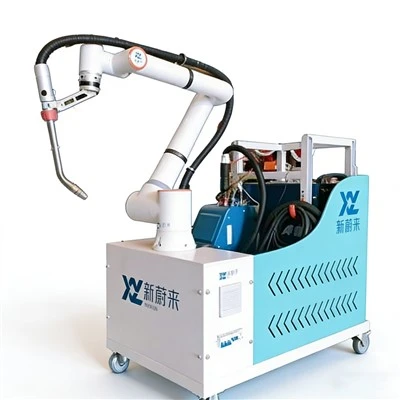
Different from traditional fixed and rail‑type welding equipment, the Magnetic Collaborative Welding Robot features core advantages including track‑free movement via permanent‑magnet attraction and flexible collaboration without fixed tooling. With such characteristics, it can adapt to diversified, non‑standard and mobile welding scenarios hardly covered by conventional welding machines, and is widely used in multiple key industrial sectors such as heavy industry, shipbuilding, new energy and infrastructure as well as pressure vessel manufacturing, boasting strong scenario adaptability.
For large‑scale steel‑structure infrastructure projects, the equipment performs well in on‑site welding for bridge steel structures, giant factory‑building steel beams and grid structures. Such workpieces are bulky and heavy and cannot be transported to fixed welding stations. Conventional manual high‑altitude welding suffers from low efficiency, large errors and prominent safety risks. In contrast, the magnetic robot can be directly attached to steel‑structure surfaces to complete continuous welding for main‑beam butt welds, stiffener fillet welds and joint splicing welds, fitting field assembly and field construction under full working conditions.
In shipbuilding and ocean engineering, it is available for welding of hull segments, ship decks, cabin steel structures and offshore platform supports. Ship welding is characterized by long weld seams, multiple curved surfaces and complicated scattered working zones. The Magnetic Collaborative Welding Robot can stably attach and travel on hull curved surfaces, vertical bulkheads and inclined decks to finish hull splicing seams, stiffener welding and deck accessory welding. It addresses difficulties in non‑standard curved‑surface welding and segmented mobile welding for ships, and fits construction environments in shipyards and docks.
For new‑energy heavy‑industry applications, it is primarily used for welding wind‑power tower cylinders, photovoltaic supports and steel structures of energy‑storage equipment. Wind‑power tower cylinders are large cylindrical curved structures incompatible with conventional welding devices. The Magnetic Collaborative Welding Robot can self‑adapt to tower‑cylinder curvature to implement automatic welding for longitudinal and circumferential welds of tower cylinders, as well as repair welding for tower‑cylinder flanges and reinforcing rings. It meets demands for mass production and on‑site installation welding for both onshore and offshore wind‑power projects.
In pressure‑vessel and storage‑equipment industries, it is deployed for construction of large oil storage tanks, gas tanks and pipeline tanks. Large tanks are mostly assembled on site with limited operating space for circumferential and longitudinal welds on tank walls, tops and bottoms. Requiring no pre‑laid rails, the robot directly adheres to metallic tank surfaces to deliver consistent continuous welding for vertical and horizontal tanks. It also supports auxiliary welding for pipeline butt joints and pipe supports.
Besides, the equipment fits non‑standard welding for engineering‑machinery components such as excavator booms, crane steel beams and tower‑crane structural parts for forming welding and repair welding of scattered welds on workpieces of varying sizes. It also applies to special scenarios including overhead high‑altitude positions, narrow gaps and outdoor non‑station environments. It replaces manual handheld welding and satisfies dual requirements for standardized mass welding and scattered non‑standard welding across industrial manufacturing, field construction and special heavy‑industry sectors.

 English
- English
- Français
- Deutsch
- 日本語
- Italiano
- Español
- Português
- русский
- 한국어
- Malti
- Čeština
- O'zbek
- Latviešu
- magyar
- Việt Nam
- فارسی
- українська
- Bai Miaowen
- हिंदी
- Norsk
- Srbija jezik (latinica)
- Kreyòl Ayisyen
- עברית
- Ελληνικά
- dansk
- bosanski
- Türkçe
- اردو
- Lietuvių
- slovenščina
- Svenska
- ไทย
- íslenska
- Cymraeg
- Gaeilgenah Éireann
- hrvatski
- slovenčina
- România limbi
- Polski
- عربي
- Català
- Eesti
- Български
- Nederlands
- বাংলা
- Indonesia
- Melayu
- suomi