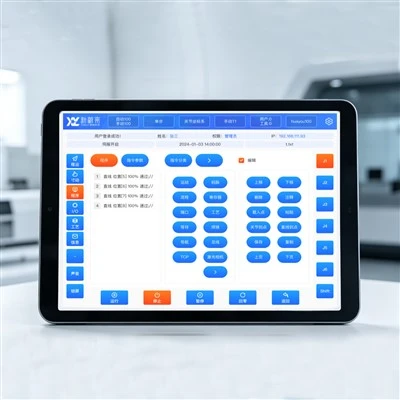
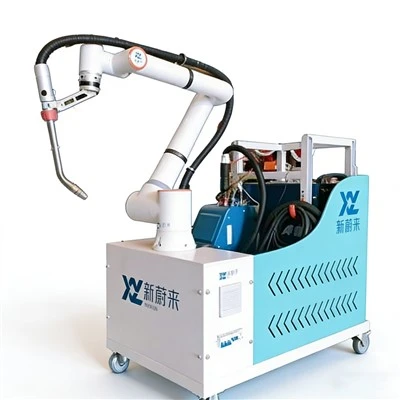
The core design philosophy of the Magnetic Collaborative Welding Robot is cost reduction, efficiency improvement and operational simplification. It completely breaks through the limitations of traditional industrial welding robots, which feature cumbersome operations and reliance on professional technicians, delivering an ultra-low learning threshold suitable for ordinary front-line factory operators. Even complete beginners can quickly grasp its operation without excessive learning pressure. In terms of operational logic, the robot abandons the complex code programming and systematic debugging modes adopted by traditional equipment. It utilizes a full visual touch interface with a concise layout and straightforward text labels. All welding functions, parameter adjustments and trajectory settings are modularized and free of complicated professional jargon, fitting the daily operational habits of factory workers and greatly reducing comprehension and operational difficulties.
Furthermore, the robot is equipped with an intelligent collaborative operating system that integrates one-click startup, automatic trajectory adaptation, intelligent weld seam recognition, automatic deviation correction and other practical functions. Traditional welding relies heavily on workers' experience to precisely control welding trajectories, speed and angles. In contrast, this robot can independently identify conventional weld positions without precise manual positioning. Operators only need to confirm working points and set basic welding parameters, and the device will complete standardized welding automatically. It fundamentally simplifies manual operational procedures and reduces the rate of operational errors, allowing users with no prior robot operation experience to quickly master basic welding workflows.
The equipment supports streamlined and efficient pre-job training with no requirement for long-term professional study. For absolute beginners, half-day practical training is sufficient to master basic operations such as start-stop control and point positioning for simple workpiece welding. After one to two days of practical exercises, operators can proficiently handle conventional welding tasks for steel structures, profiles, plates and other common workpieces. Workers with traditional welding experience can achieve full independent operation in merely half a day without continuous on-site guidance, perfectly catering to factory staff rotation and rapid new employee induction requirements.
In addition, the robot supports manual fine-tuning and permanent storage of commonly used welding parameters. For standardized workpiece welding in daily factory production, initially set parameters can be saved permanently in the system and recalled with a single click for subsequent welding of similar workpieces, eliminating repeated debugging and further simplifying daily operations. Its magnetic adsorption design requires no complex tooling fixation, enabling easy placement and positioning and minimizing pre-operation preparation time.
Moreover, the robot is fitted with a safety linkage protection system. It can automatically issue early warnings and perform fine corrections in the event of minor operational deviations or equipment displacement during operation, preventing sudden failures and welding errors and greatly improving operational fault tolerance. In summary, this robot eliminates the reliance on professional technicians inherent to traditional industrial robots and is fully accessible to ordinary factory workers. With low learning costs, fast skill acquisition and stable operational performance, it can be rapidly deployed in diverse welding scenarios and effectively addresses industry pain points such as the shortage of skilled welders and slow new employee onboarding.

 English
- English
- Français
- Deutsch
- 日本語
- Italiano
- Español
- Português
- русский
- 한국어
- Malti
- Čeština
- O'zbek
- Latviešu
- magyar
- Việt Nam
- فارسی
- українська
- Bai Miaowen
- हिंदी
- Norsk
- Srbija jezik (latinica)
- Kreyòl Ayisyen
- עברית
- Ελληνικά
- dansk
- bosanski
- Türkçe
- اردو
- Lietuvių
- slovenščina
- Svenska
- ไทย
- íslenska
- Cymraeg
- Gaeilgenah Éireann
- hrvatski
- slovenčina
- România limbi
- Polski
- عربي
- Català
- Eesti
- Български
- Nederlands
- বাংলা
- Indonesia
- Melayu
- suomi