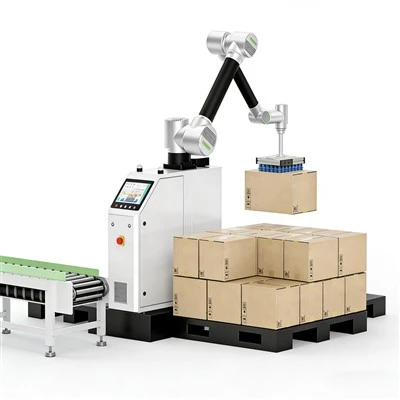
Compared with manual palletizing, traditional industrial palletizing robots and truss palletizing equipment, Collaborative Cobot Palletizer delivers comprehensive differentiated advantages and precisely meets the automation upgrading requirements of micro, small, medium and large enterprises. Its core strengths cover five key dimensions: safety performance, deployment flexibility, production efficiency, operational cost and scenario adaptability, making it the optimal palletizing solution for flexible industrial production.
First, it enables ultra-safe, fence-free human-machine collaborative operation, its most distinctive competitive edge. Traditional industrial palletizing equipment belongs to high-speed, heavy-duty machinery with substantial operational risks, requiring enclosed safety fences and independent working zones that completely separate humans from machines and prohibit collaborative work. In contrast, Collaborative Cobot Palletizer is equipped with high-precision flexible force sensors and intelligent visual perception systems to monitor personnel and obstacles within the working range in real time. When close contact or collision hazards are identified, it decelerates and buffers to an immediate stop without rigid impact, causing no harm to personnel or materials. Requiring no safety barriers, it supports synchronous human-machine collaborative work in the same workspace, ensuring continuous production while completely eliminating personal injury risks stemming from high-altitude stacking and heavy material handling in manual operations, suitable for all open workshop scenarios.
Second, it offers flexible deployment with extremely low renovation costs. Traditional automatic palletizing equipment is bulky and structurally fixed, requiring dedicated space, infrastructure reinforcement and circuit retrofitting. Its deployment cycle often lasts weeks or months, and it cannot be relocated after installation. Collaborative Cobot Palletizer adopts an integrated lightweight design with simple installation and no complex infrastructure requirements. It can be fully commissioned and operational on the day of power connection and flexibly repositioned to suit different production lines and working stations. For product specification and pallet pattern adjustments, only simple parameter debugging is required to complete rapid line changeover, perfectly adapting to multi-variety, small-batch flexible production and thoroughly resolving the issue of fixed-function, idle-prone traditional equipment.
Third, it ensures efficient and stable operation with superior accuracy over manual work. Manual palletizing suffers from fluctuating efficiency due to physical fatigue, mood and stamina limitations, and prolonged manual operation frequently results in skewed stacking, layer misalignment and material damage, with no capacity for round-the-clock production. Equipped with a micron-level repeat positioning system, Collaborative Cobot Palletizer achieves precise stacking and standardized pallet patterns with a near-zero material damage rate. It maintains a stable operating rhythm of 8 to 16 cartons per minute and supports 24-hour uninterrupted operation, with daily output equivalent to that of 4 to 6 workers. It substantially improves production efficiency while standardizing palletizing quality to facilitate subsequent warehousing handling and inventory management.
Fourth, it is user-friendly with low maintenance costs. Traditional industrial robots require professional engineers for debugging and maintenance, incurring high labor expenses. Collaborative Cobot Palletizer features an intuitive visual operating system. Ordinary workshop staff can independently complete pallet pattern configuration, parameter modification, equipment start-stop control and daily debugging after short-term training without professional technical support. With a streamlined structure and low failure rate, it only requires basic cleaning and routine maintenance. Its energy consumption is far lower than that of traditional heavy-duty equipment, reducing comprehensive operating costs by over 50%. Most units achieve full investment payback within 8 to 10 months, delivering outstanding cost performance.
Fifth, it boasts wide adaptability and strong compatibility. It supports mainstream palletizing loads ranging from 5 to 25 kilograms and is compatible with cartons, plastic crates, bagged goods, barreled products and boxed materials. It can be integrated with end-of-line production stations, manual feeding stations and warehousing sorting stations, meeting both basic palletizing demands of small factories and large-scale flexible production requirements of industrial enterprises, with markedly higher universality and practicality than traditional palletizing equipment.

 English
- English
- Français
- Deutsch
- 日本語
- Italiano
- Español
- Português
- русский
- 한국어
- Malti
- Čeština
- O'zbek
- Latviešu
- magyar
- Việt Nam
- فارسی
- українська
- Bai Miaowen
- हिंदी
- Norsk
- Srbija jezik (latinica)
- Kreyòl Ayisyen
- עברית
- Ελληνικά
- dansk
- bosanski
- Türkçe
- اردو
- Lietuvių
- slovenščina
- Svenska
- ไทย
- íslenska
- Cymraeg
- Gaeilgenah Éireann
- hrvatski
- slovenčina
- România limbi
- Polski
- عربي
- Català
- Eesti
- Български
- Nederlands
- বাংলা
- Indonesia
- Melayu
- suomi