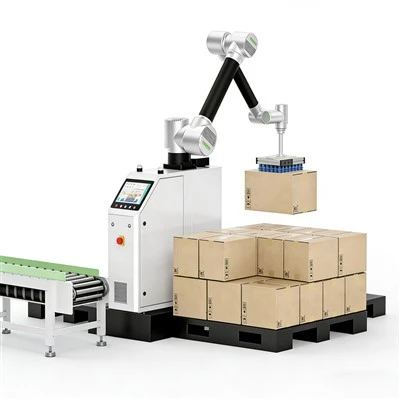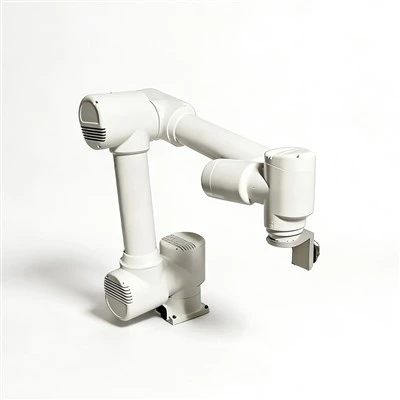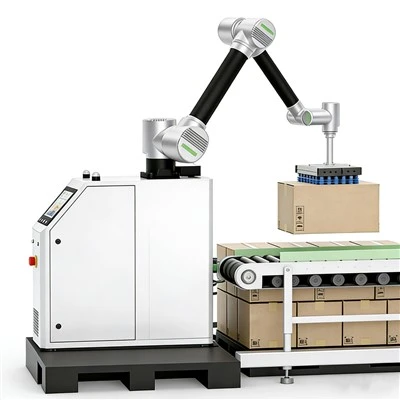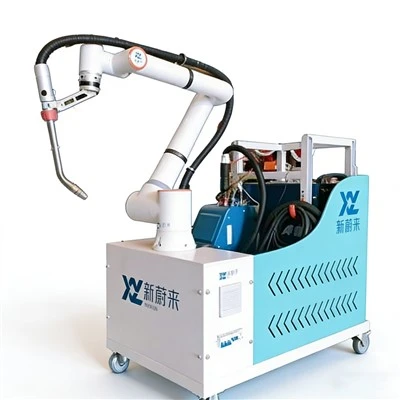

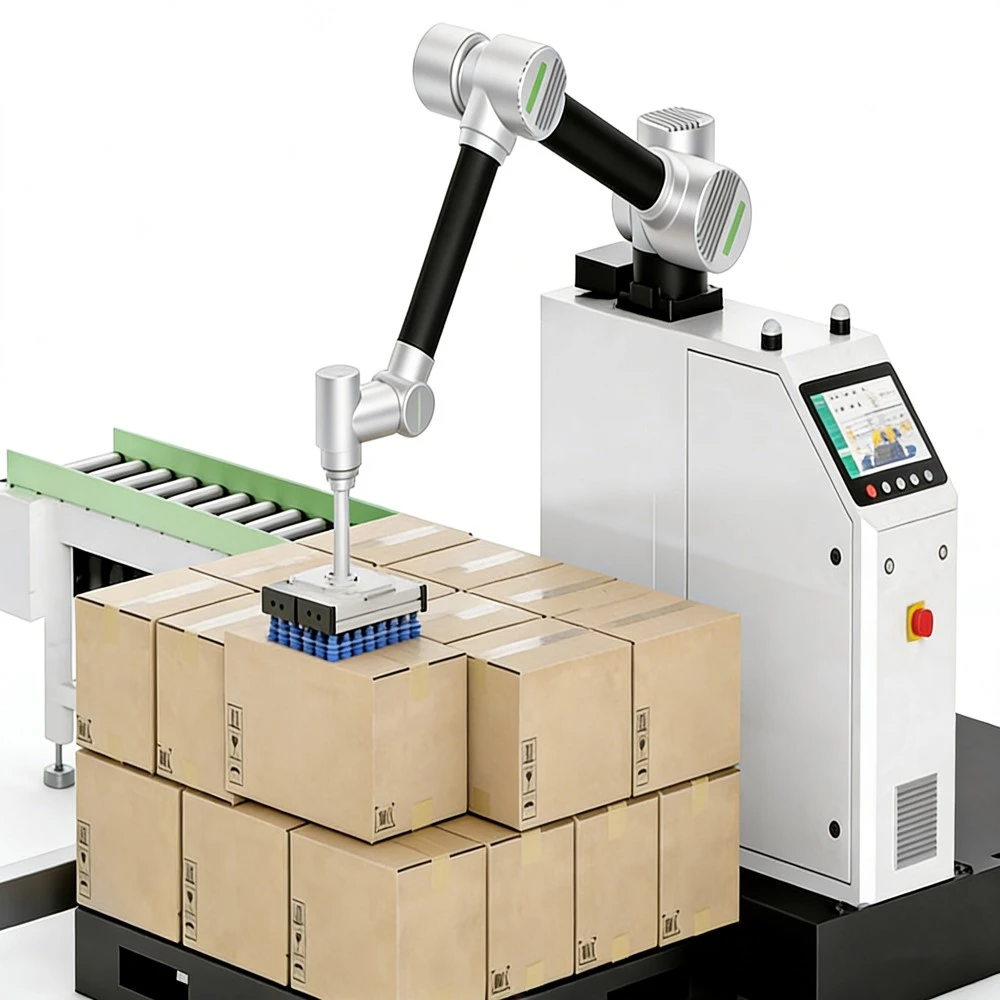
The Palletizing Robot is an intelligent industrial device integrating machinery, electronic control, sensing and automatic programming. Its core working principle relies on programmed control and multi‑component coordination to replace manual labor for the whole process of automatic grabbing, handling, layered stacking and full‑pallet forming of materials. It is widely applied in end‑of‑line finished‑goods palletizing and raw‑material warehousing palletizing, with core features of high precision, high repeatability and full automation. Its complete operation relies on four major core modules functioning synergistically.
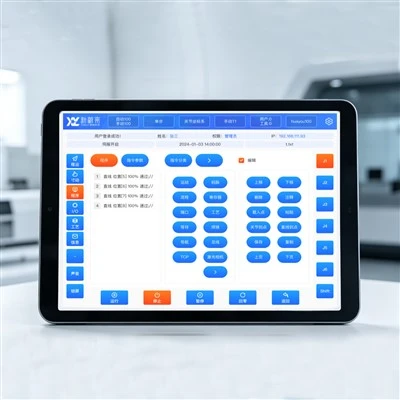
The first module is the core control system, regarded as the "brain" of the robot, which consists of PLC controllers, industrial hosts and programming software. Operators input operating parameters via a teach pendant in advance, including cargo length, width, height, weight, stacking layers, pallet patterns, placement gaps and offset error thresholds. Parameters for grabbing speed, moving trajectory and lifting height are also configured. The system converts all parameters into accurate motion instructions, coordinates equipment operation in real time and adjusts component movements to guarantee standard operation.
The second module covers servo drive and transmission mechanisms, serving as the power center. It comprises servo motors, reducers and transmission lead screws. Upon receiving instructions from the control system, servo motors output accurate power. Reducers reduce speed and increase torque to drive the mechanical arm to perform multi‑dimensional motions including horizontal translation, vertical lifting and rotary swinging. The servo system delivers millisecond‑level response and micron‑level positioning. It prevents motion stalling and position deviation and restricts positioning error within ±0.5 mm to ensure reliable grabbing and palletizing.
The third module refers to end‑of‑arm actuators or grippers which make direct contact with materials. Multiple interchangeable gripper types such as suction‑cup type, clamp type, splint type and hook type are available for cartons, bags, barrels and boxes. During operation, pressure and distance sensors integrated on grippers detect material positions and fitting conditions to realize precise grabbing, clamping and releasing. Firm holding is guaranteed without dropping, while squeezing damage to goods is avoided.
The fourth module is the sensing and linkage system composed of position sensors, photoelectric sensors and safety sensors. When conveyor lines run, photoelectric sensors detect material arrival signals to trigger robot startup. Position sensors feed back mechanical‑arm coordinates for real‑time trajectory correction. Safety sensors monitor obstacles within working zones and trigger an emergency stop for risk prevention. The closed‑loop workflow proceeds as follows: materials arrive at designated positions, sensors send trigger signals, the mechanical arm performs precise grabbing, position adjustment is completed through trajectory translation, layered stacking is implemented for pallet forming, and the robot resets after full‑pallet completion. No human intervention is required throughout the whole cycle. 24‑hour non‑stop cyclic operation can be achieved to satisfy automatic production demands of industrial assembly lines.