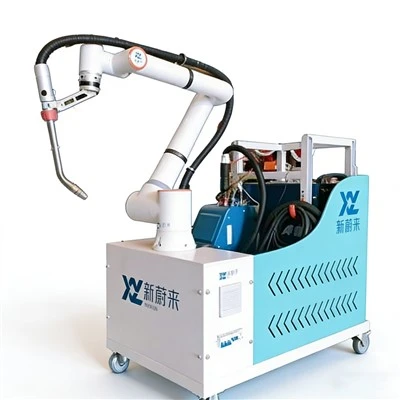

The Mobile Collaborative Welding Robot delivers superior stability and neatness of weld appearance, which cannot be achieved by pure manual welding. It thoroughly addresses industry pain points of manual welding including uneven welds, frequent defects and large differences between batches. It standardizes and unifies welding appearance, greatly improving the finished quality and grade of workpieces. It is particularly ideal for producing parts with strict requirements on welding appearance.
Instability is a common issue in manual welding, which mainly stems from uncontrollable human factors. A welder's technique, hand stability, working state, fatigue level and even mood directly affect weld formation. After long hours of continuous welding, welders' arms will ache and shake. This causes inconsistent welding travel speeds, offset torch angles and uneven wire feeding, resulting in welds with varying widths, irregular heights and chaotic patterns. Besides, welders differ in skill levels and operating habits. If the same batch of workpieces is welded by different people, the finished appearance will vary greatly and undermine product consistency.
Furthermore, manual welding easily produces various appearance defects, such as weld beads, undercutting, blowholes, slag inclusions, incomplete filling and weld offset. Once defects emerge, secondary polishing and rework are required. This increases labor hours and production costs, damages the overall look of workpieces and may even lead to scrap parts and lower production yield. For mass production, manual welding cannot guarantee uniform weld standards for every product. Batch quality fluctuates heavily and struggles to meet standardized large-scale manufacturing requirements.

The Mobile Collaborative Welding Robot eliminates human errors from the source and realizes consistent weld formation. The whole working process is automated and standardized. Welding current, voltage, travel speed, wire feed rate and torch angle are all precisely maintained at constant values. No human interference errors occur. No matter how long the continuous operation lasts or how many workpieces are produced in batches, the equipment maintains consistent welding parameters and trajectories. Every weld has uniform width, height and line density, presenting a smooth, neat and visually consistent finish.
In addition, the equipment is equipped with intelligent weld calibration functions. It can independently adapt to minor deviations in workpiece welding positions, accurately follow welding paths and effectively avoid offset welding, missing welds and excessive build-up commonly seen in manual work. Appearance defects are reduced substantially. One-pass welding achieves the required forming without frequent post-polishing and rework. It not only maintains high standards for weld appearance but also saves labor and time costs for subsequent finishing procedures.
The advantages of the robot become more prominent in mass production scenarios. Weld appearances of the whole batch of workpieces are highly unified without obvious differences, perfectly fitting the standardized production requirements of industrial goods. It can effectively raise overall product quality and market competitiveness. In contrast to the randomness and instability of manual welding, robotic welding enables standardized and stable output of weld appearance. It acts as core equipment for manufacturing industries to improve welding quality, boost productivity and cut costs.