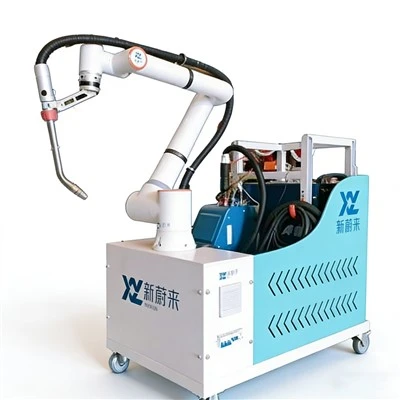

The Mobile Collaborative Welding Robot has strong adaptability to material thickness and can perfectly accommodate welding operations of mainstream metal materials of different thicknesses in industrial production. It covers thin plates, medium plates and medium-thick plates for conventional workpieces. It satisfies multi-variety and multi-specification welding production needs of most manufacturers. There is no need to replace equipment or conduct complex modifications when switching between materials of different thicknesses, offering outstanding flexible production capacity.
In real industrial production, workpieces vary greatly in material thickness. Precision hardware components are mostly thin plates, while structural supports, mechanical fittings and equipment frames are usually medium-thick plates. Materials of different thicknesses have vastly different requirements for welding parameters, heat input and welding speeds. Human welders can adjust parameters based on experience, yet stability is low and error tolerance is poor. Traditional fixed welding equipment has limited parameter adjustment functions and narrow thickness adaptability. Switching workpieces of different thicknesses requires lengthy debugging and severely reduces production efficiency.
The Mobile Collaborative Welding Robot is optimized for thickness adaptation systems. Multiple sets of mature welding parameter models are pre-installed to fit mainstream metals including steel and stainless steel of different thicknesses. For thin plate materials, the equipment precisely lowers heat input, accelerates welding speed and controls wire feeding volume accurately. It effectively prevents common thin plate welding problems such as burn-through, deformation and collapse, ensuring smooth welding without damage and high forming precision. For medium-thick plate materials, it automatically matches appropriate high current, welding rhythm and multi-layer multi-pass welding trajectories to guarantee sufficient weld penetration and reliable bonding, avoiding false welding and insufficient penetration.
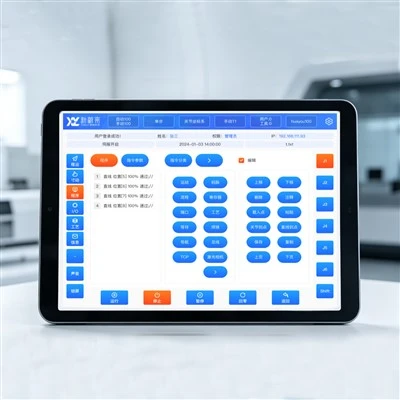
Parameters can be adjusted visually and simply on the equipment. When switching workpieces of different thicknesses, operators do not need professional technical debugging. They only need to select the corresponding welding mode or tweak parameters slightly according to workpiece thickness for rapid production changeover. This completely solves the problems of cumbersome changeover and poor adaptability of traditional equipment. Meanwhile, the intelligent adaptive system can adjust welding status in real time. It can optimize welding parameters autonomously for minor uneven thickness on a single workpiece and maintain stable overall welding quality.
This advantage is particularly valuable under multi-variety and small-batch production modes. Enterprises do not need to purchase multiple welding devices for workpieces of different thicknesses. A single Mobile Collaborative Welding Robot can handle welding tasks for conventional workpieces of all common thickness ranges, greatly reducing equipment procurement costs and space occupation. In addition, the robot can move flexibly between stations to support synchronous production of workpieces with different thicknesses on various production lines, substantially improving workshop flexibility and versatility.
In summary, this robot breaks the limitation of single thickness adaptability of traditional welding equipment. It realizes full coverage of materials with varied thicknesses and meets both precision welding for thin plates and strong bonding requirements for thick plates. It fits a wide range of industrial welding scenarios and provides solid support for enterprises to carry out flexible and diversified production.