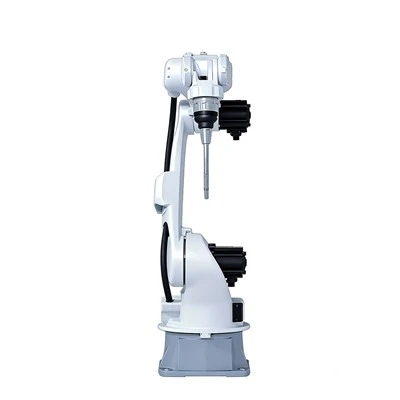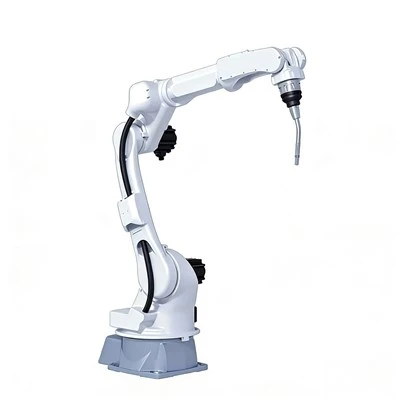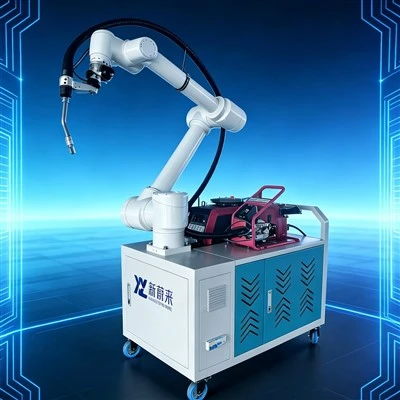


The 1600 Arm Span Collaborative Welding Robot features mature industrial-grade structural design and an intelligent control system, granting exceptional operational stability and environmental adaptability. It serves as a reliable mass-production welding solution for medium and small workpieces, with its core stability advantages divided into four dimensions: mechanical structure, motion control, environmental compatibility and long-term operational durability.
Starting with mechanical structural performance, the robot employs an integrated cast aluminum rigid body with an optimized six-axis joint layout. Mechanical simulation adjusts arm thickness and joint connecting structures to maximize overall rigidity, counteracting vibration generated by arc impact, machine startup and high-speed displacement during welding. This hardware design fundamentally prevents trajectory deviation and welding torch jitter that compromise weld quality. Compared with standard compact welding robots, its 1600mm arm span features a perfectly balanced structural ratio, eliminating insufficient end rigidity and excessive shaking common in overlong robotic arms and drastically boosting stability at the working end.
In terms of motion control, this model is equipped with exclusive high-precision motion control technology that enables full-process adaptive trajectory calibration. Whether executing low-speed precision welding or high-speed continuous production, the robot strictly replicates pre-programmed welding paths with a repeat positioning accuracy of ±0.05mm and stable path repeatability. This completely resolves pain points of trajectory distortion and coordinate offset during high-speed movement plaguing traditional robotic equipment. Additionally, the robot integrates intelligent vibration suppression and buffer adjustment logic to deliver seamless acceleration, deceleration and corner transitions without inertial shaking-induced welding defects, guaranteeing uniform quality across all welds.
For environmental adaptive stability, the robot exhibits robust anti-interference performance, compatible with complex industrial workshop conditions including voltage fluctuations, minor ground vibration and temperature & humidity variation. A built-in environmental adaptive compensation system corrects precision errors caused by ambient factors in real time. The robot supports 24-hour round-the-clock mass production without stuttering or trajectory drift under full load, delivering far superior continuous-operation stability compared to ordinary collaborative robots.
Regarding long-term operational stability, the 1600 Arm Span Collaborative Welding Robot uses wear-resistant precision components for core transmission parts, with fully sealed joints that reduce abrasion from dust and oil contamination to slow long-term accuracy degradation. After tens of thousands of hours of industrial durability testing, the robot retains repeat positioning accuracy within standard tolerance ranges even after years of service. It features a long mean time between failures (MTBF) and ultra-low fault rates, eliminating frequent calibration and adjustment work. This ensures uninterrupted production line operation, minimizing downtime risks and maintenance costs to fully meet the stability demands of industrial mass welding production.