
Safety considerations for collaborative robots cover four core aspects: risk assessment, physical protection, operating procedures, and emergency mechanisms, ensuring the safety of personnel and equipment during human-robot collaborative operations. The following are key points summarized based on international standards (such as ISO 10218, ISO/TS 15066) and industry practices:
Systemic Risk Assessment First
Before deploying collaborative robots, a comprehensive risk assessment must be conducted, covering the entire task cycle and workspace:
Assessment content includes robot load, speed, torque, and end-effector hazards (such as sharp edges, high temperatures).
Consider operator positioning, path, fixture layout, and environmental factors (such as chemicals, radiation).
Classify collaboration levels (S0-S3) based on contact frequency and develop corresponding protection strategies.
Load Matching: A 20% margin should be allowed (e.g., select a 30kg model if the actual load is 24kg).
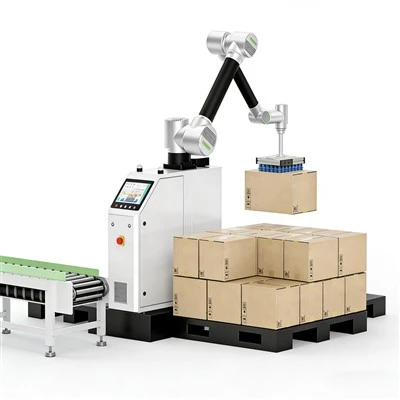
End-of-Edge Tools: Suction cup grippers are suitable for flat packaging (air consumption ≤126L/min), while sponge grippers are suitable for fragile items. We currently have these products in stock. Our collaborative palletizing robots support loads of 20-30kg, with palletizing speeds up to 12 pieces/minute. Suction cup or sponge grippers are available, with precise positioning ±0.035mm. Contact us for the best solution.