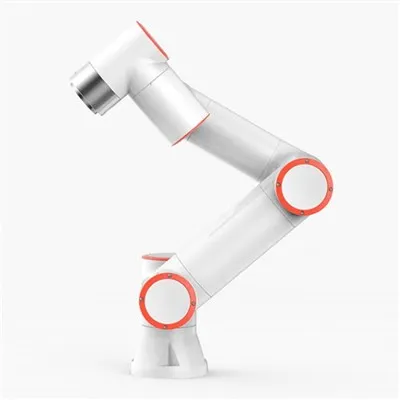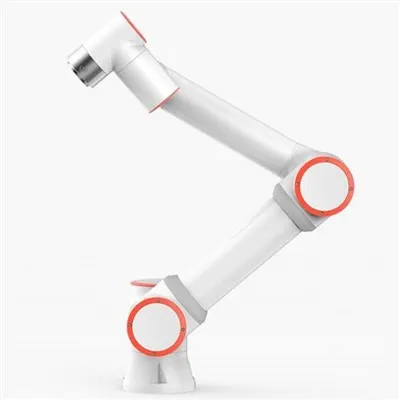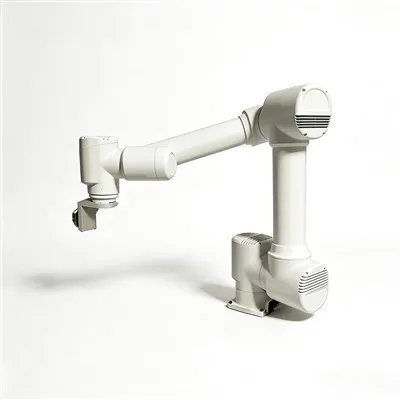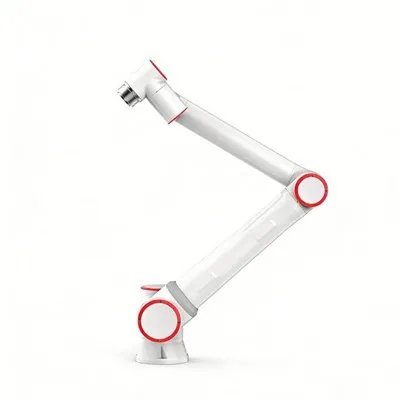

Collaborative robots (Cobots) are industrial robots capable of safely collaborating with humans in shared workspaces. Their working principle is based on the following core technologies:
Force Sensors and Collision Detection: Collaborative robots are typically equipped with high-precision force/torque sensors to monitor joint forces in real time. When an abnormal external force (such as contact with a human) is detected, the system stops moving or switches to compliant mode within milliseconds (typical force threshold setting is 5-50N).
Lightweight Design and Low Inertia: Using magnesium alloy or carbon fiber materials (commonly weighing <30kg), combined with low reduction ratio joints (such as harmonic reducers), ensures that the kinetic energy during a collision is below the safety limits specified in the ISO/TS 15066 standard (the permissible energy transfer range for various parts of the human body is 10-140J).
Motion Control Algorithms: Dynamic stiffness adjustment is achieved through impedance control or admittance control algorithms. For example, in polishing applications, axial stiffness can be set to 0.1-1 N/mm, while assembly tasks require fine-tuning capability of 0.01-0.1 N/mm.
Human-Machine Interface: Supports drag-and-drop teaching (requires a guiding force of <5N), AR visual programming, or voice commands, lowering the operational threshold. Some models are equipped with a 3D vision system (positioning accuracy ±0.05mm) to achieve real-time dynamic obstacle avoidance.