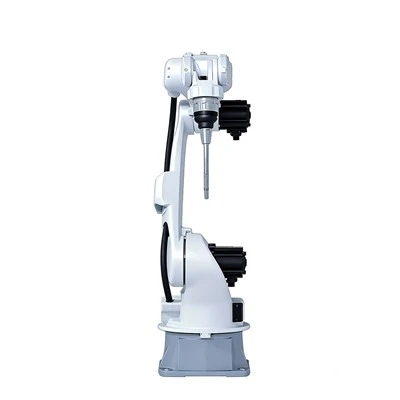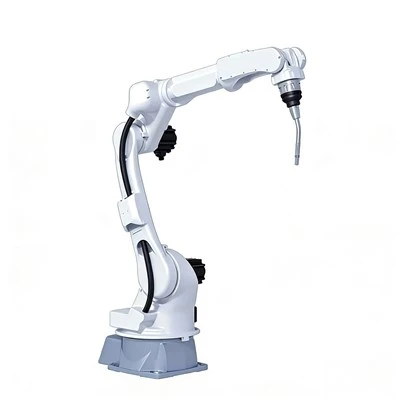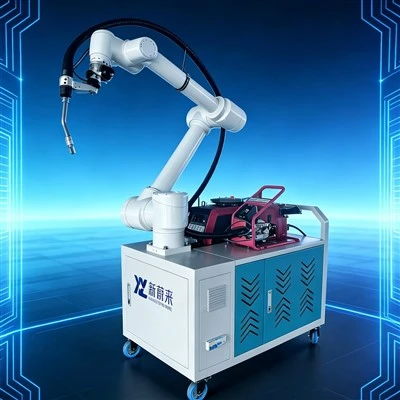

The 1600 Arm Span Collaborative Welding Robot combines high-precision trajectory control, intelligent parameter adaptation and stable welding power output to generate exceptionally high-quality, uniformly consistent weld formations. It fully satisfies rigorous standards for precision welding, cosmetic weld finishes and load-bearing structural welding across multiple industrial sectors. Its weld bead surface quality, internal mechanical performance and batch production consistency all surpass manual welding and conventional automated welding equipment.
First, regarding surface weld formation quality, the 1600 Arm Span Collaborative Welding Robot relies on its stable motion control system to maintain vibration-free, offset-free and speed-stable welding travel throughout the full weld path. The resulting finished weld beads feature consistent width, straight linearity and smooth, seamless corner transitions with finely uniform, evenly distributed ripple patterns. It eliminates common cosmetic flaws from manual welding including inconsistent bead width, chaotic ripple textures, overlap and weld collapse. For complex forming requirements such as straight welds, circular seams, curved joints and multi-angle butt welds, the robot precisely replicates pre-programmed trajectories to guarantee identical weld appearance across all mass-produced workpieces. Batch cosmetic consistency is drastically improved, completely resolving the issue of uneven finished weld quality inherent to manual welding.
Second, for internal weld quality and forming precision, the robot' s integrated intelligent welding adaptive system automatically calculates and applies optimal welding current, voltage, wire feed speed and weaving frequency parameters for workpieces made from carbon steel, stainless steel, aluminum alloy and thin sheet metal. It simultaneously compensates for thermal deformation and trajectory deviation generated during welding in real time. Welding heat input is precisely regulated with evenly distributed thermal energy to avoid overheating, burn-through, cold laps, incomplete penetration, porosity and undercut - all frequent standard welding defects. Weld fusion penetration reaches uniform, qualified depth with excellent fusion between weld metal and base material. Fully dense, filled weld beads contain no slag inclusions or cracks, delivering stable mechanical welding performance with tensile and compressive strength complying with global industrial standards. This satisfies strict welding quality requirements for load-bearing structural frames and precision equipment components.

For challenging thin-walled and irregular small workpieces, the robot delivers exceptional stability during low-speed welding with smooth travel and precise parameter control to effectively limit thermal deformation of thin base materials. Post-weld workpieces retain high flatness, drastically reducing workload for subsequent grinding and polishing procedures; select precision components can achieve finished welds with zero grinding required. The robot supports multiple welding processes including pulse welding and gas metal arc welding (GMAW/MIG), offering flexible adaptation to diverse forming demands. Thick workpieces receive sufficient fusion penetration while thin sheets avoid burn-through and deformation, delivering outstanding cross-material compatibility.
In terms of mass production stability, the 1600 Arm Span Collaborative Welding Robot operates via fully automated standardized workflows unaffected by individual welder skill levels or daily performance fluctuations. Zero deviation variance occurs in weld formation during batch production, pushing finished product pass rates above 99% to drastically cut reject rates and rework costs. Overall, welds produced by this robot combine outstanding cosmetic finish, dimensional precision and long-term structural stability, balancing aesthetic craftsmanship and mechanical load-bearing strength. It fully meets high-standard weld forming requirements across consumer goods, industrial machinery, metal structural components and automotive parts sectors.