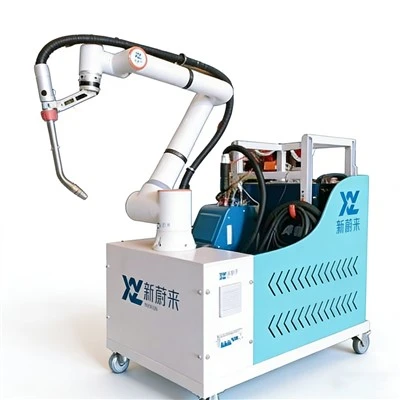

Welding Collaborative Robots can help companies improve production efficiency by automatically performing repetitive welding operations. During traditional manual welding, workers may need to handle not only the actual welding process but also workpiece positioning, welding preparation, posture adjustments, and coordination between different operations. These additional tasks can affect the overall production rhythm. By using a Welding Collaborative Robot, some repetitive welding tasks can be assigned to the robot, helping make the entire production process more continuous.
First, a Welding Collaborative Robot can reduce the time required for repetitive operations. When similar workpieces are produced continuously, the robot can repeatedly perform programmed movements and welding tasks without frequently changing its operating rhythm like a human operator. For highly repetitive welding applications, this continuous operation can help improve workflow efficiency.
Second, the robot can maintain a relatively consistent working rhythm. Manual welding can be affected by fatigue, working hours, and repetitive movements. As working time increases, an operator's speed and concentration may change. A Welding Collaborative Robot can follow its programmed workflow continuously and maintain a relatively stable operating pattern under appropriate working conditions. This can help reduce fluctuations in production caused by changes in operator performance.
A Welding Collaborative Robot can also reduce the amount of time workers spend on high-frequency repetitive welding operations. Depending on the production process, workers can focus on workpiece preparation, loading and unloading, inspection, and other supporting tasks while the robot performs the welding operation. By assigning tasks appropriately between people and robots, companies can make better use of their workforce while reducing the physical burden of repetitive welding work.
For companies engaged in continuous production, a Welding Collaborative Robot can also help establish a more consistent production process. When welding tasks are clearly defined, the robot can be integrated into the existing workflow so that welding operations coordinate more effectively with other production stages. This can improve not only the efficiency of the welding process itself but also the overall organization and flow of production.
However, using a Welding Collaborative Robot does not automatically guarantee higher production efficiency in every situation. Actual results can also be affected by workpiece preparation, loading and unloading, fixture coordination, welding procedures, and operator practices. If the processes before and after welding are poorly coordinated, the robot may still experience unnecessary waiting or interruptions even when it operates normally. Therefore, the robot's role should be planned according to the actual production workflow.
Overall, Welding Collaborative Robots are particularly suitable for repetitive welding tasks with clearly defined processes. By reducing repetitive manual operations, maintaining a stable working rhythm, and improving coordination between production stages, they can help companies increase welding efficiency and improve overall production organization.