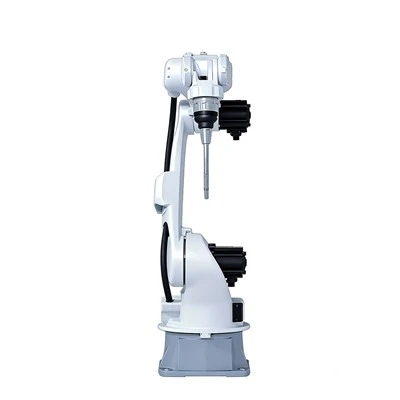
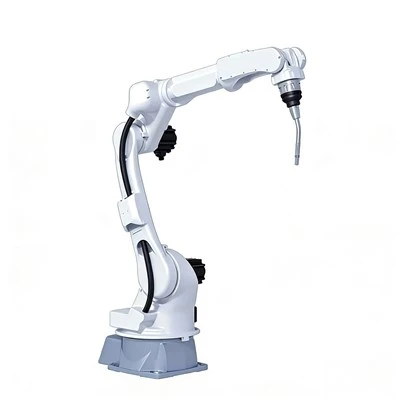
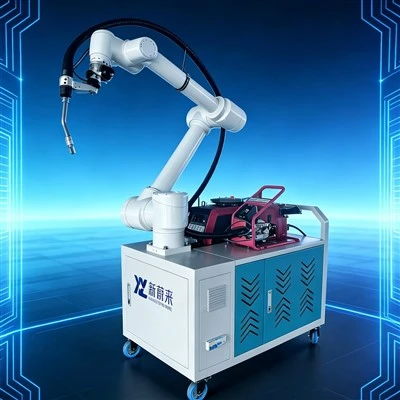
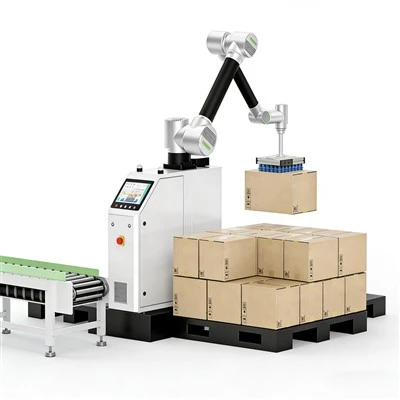
The 1600mm arm span constitutes the most balanced golden dimensional specification engineered specifically for medium and small industrial welding production environments, validated and refined through thousands of real-world industrial manufacturing working condition tests. It delivers unmatched cross-scenario adaptation advantages across five critical performance dimensions: maximum workpiece working coverage range, end-effector operational precision & stability, overall machine floor space compatibility, six-axis motion fluidity and universal cross-workpiece scenario compatibility. These advantages cannot be replicated by either shorter compact arm span robotic models or oversized long-arm heavy-duty robotic welders. It precisely aligns with the standard workpiece dimensional ranges and constrained factory floor layouts prevalent across medium and small manufacturing workshops nationwide, establishing it as the robotic welding arm span specification with the broadest universal cross-industry applicability.
First, advantages in workpiece dimensional matching & full working range coverage. Over 90% of all commonly processed metal workpieces across core manufacturing verticals including metal hardware fittings, automotive miniature components, light construction machinery support frames, sheet metal tubular assemblies and household metal structural frames feature maximum dimensional extents falling within the 1000mm–1500mm size bracket. The 1600mm arm span delivers complete unobstructed coverage of this full dimensional spectrum with no blind operating zones, eliminating repeated workpiece re-fixturing and workstation repositioning. Operators complete full welding of entire workpieces in a single fixture setup, drastically reducing auxiliary non-welding cycle time and boosting overall production throughput efficiency. When benchmarked against shorter arm span models (1200mm, 1400mm), this robot boasts an expanded maximum working radius capable of accommodating the upper size limit of medium industrial workpieces and supporting synchronized multi-station welding workflows. It eliminates key pain points of insufficient working coverage range that force repeated secondary fixture repositioning and introduce cumbersome multi-stage welding procedures inherent to compact short-arm robotic welders, delivering a far broader compatible workpiece dimensional spectrum.
Second, advantages in end-effector operational precision & mechanical stability matching. When compared to robotic welding equipment with arm spans of 1800mm and 2000mm or longer heavy-duty specifications, the 1600mm arm span features a perfectly balanced mechanical torque distribution ratio across all six robotic axes. Its suspended extended arm length is moderately sized to minimize end-effector rigidity loss, eliminating end-arm mechanical shaking and precision degradation during high-speed welding travel and extended continuous weld path operation. Its repeat positioning accuracy and long-term weld trajectory stability vastly outperform oversized long-arm robotic welders. Long-arm heavy-duty robots frequently suffer from end-arm vibration and weld path positional drift when executing precision micro-welding on small delicate workpieces, a flaw completely eliminated in the 1600mm arm span model. This machine achieves the ideal dual balance of sufficient maximum working range capacity and ultra-high end-effector welding precision, seamlessly accommodating two distinct production use cases: precision micro-welding of miniature delicate components and continuous long-seam mass welding of medium-sized structural frames.
Third, outstanding advantages in factory workshop floor space layout compatibility. The robotic welder with a 1600mm arm span features a compact integrated mechanical body with minimal overall floor space occupation, with total machine physical volume drastically smaller than heavy-duty long-arm robotic welding equipment. It does not require expansive dedicated production workstation floor space, fitting perfectly within cramped small-scale manufacturing workshops, legacy aging factory buildings, densely packed integrated production line layouts and narrow compact individual welding workstations. The robot supports multiple flexible installation configurations including floor standing base mounting, vertical wall mounting, overhead inverted ceiling mounting and mobile portable workstation integration. It adapts seamlessly to narrow side-by-side production line integration and standalone independent welding workstation deployment without requiring large-scale costly structural renovation of existing factory premises. This drastically cuts upfront production line site deployment capital expenditure and eliminates restrictive floor space threshold barriers, perfectly matching the constrained factory floor space realities facing nearly all medium and small manufacturing enterprises.
Fourth, superior working condition adaptation tolerance and flexible production compatibility. The moderately sized 1600mm arm span enables optimized six-axis joint rotational angle geometry with seamless fluid motion during rotation, pitch and flip articulation, eliminating mechanical motion interference dead zones. It adapts effortlessly to welding tasks for complex irregularly shaped workpieces requiring multi-angle weld joint access and deep inner seam welding operations. Additionally, the robot exhibits minimal inertial positional error during startup, acceleration, deceleration and direction reversal motion sequences, delivering elevated motion control precision alongside simplified workpiece re-teaching and program reconfiguration workflows. It supports ultra-fast production switching between multi-specification, multi-dimensional metal workpieces, with flexible operational adaptability and cross-working condition compatibility vastly exceeding robotic welders with shorter or longer alternative arm span specifications. Overall, the 1600mm arm span model stands as the robotic welding equipment specification delivering the most comprehensive balanced adaptation performance across all medium and small industrial welding production working conditions.

 English
- English
- Français
- Deutsch
- 日本語
- Italiano
- Español
- Português
- русский
- 한국어
- Malti
- Čeština
- O'zbek
- Latviešu
- magyar
- Việt Nam
- فارسی
- українська
- Bai Miaowen
- हिंदी
- Norsk
- Srbija jezik (latinica)
- Kreyòl Ayisyen
- עברית
- Ελληνικά
- dansk
- bosanski
- Türkçe
- اردو
- Lietuvių
- slovenščina
- Svenska
- ไทย
- íslenska
- Cymraeg
- Gaeilgenah Éireann
- hrvatski
- slovenčina
- România limbi
- Polski
- عربي
- Català
- Eesti
- Български
- Nederlands
- বাংলা
- Indonesia
- Melayu
- suomi