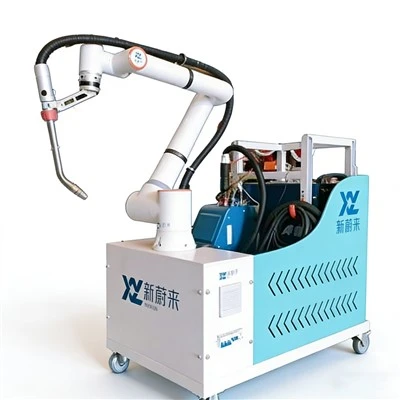

An Industrial Welding Robot can improve production efficiency mainly because it can execute repetitive welding operations automatically according to programmed instructions. During manual welding, operators need to continuously perform tasks such as handling, positioning, welding, and adjusting their working posture. Long periods of operation may be affected by fatigue, individual working habits, and differences in operating pace. In contrast, a robot can perform repetitive welding movements according to a preset program, helping make the production process more consistent.
First, a robot can maintain a relatively stable working cycle. For workpieces with identical or similar structures, once the welding program has been properly configured, subsequent workpieces can be welded along the same or appropriately adjusted path. This reduces variations in production time caused by differences in individual operating habits and makes the production process easier to organize.
Second, an Industrial Welding Robot can continuously perform repetitive tasks. Under appropriate equipment configurations and production conditions, the robot can operate according to its programmed instructions for extended periods without requiring the breaks normally associated with manual welding. This characteristic is particularly useful in production environments involving numerous weld seams and highly repetitive operations.
Robotic welding can also reduce certain repetitive manual tasks. For example, after the workpiece has been properly positioned, the robot can automatically move the welding torch to the designated location and complete the welding operation along the programmed path. Operators can then focus more on workpiece preparation, equipment monitoring, quality inspection, and production management, which can improve the overall allocation of labor and equipment.
Robotic welding can also contribute to greater consistency in the welding process. Once the welding path, travel speed, and relevant process parameters have been properly configured, the robot can repeatedly execute the same program. This can help reduce variations caused by differences in manual operation. When welding quality remains consistent, the need for rework or repeated processing may also be reduced, which can improve overall production efficiency.
However, installing an Industrial Welding Robot does not automatically guarantee a significant increase in efficiency. Actual productivity is also affected by factors such as workpiece loading and unloading time, clamping time, welding processes, robot operating speed, fixture design, and overall production cycle time. If the robot welds quickly but loading and unloading take a long time, overall production efficiency may still be limited.
Therefore, when using an Industrial Welding Robot, the robot itself, welding equipment, fixtures, workpiece positioning, and material handling processes should be considered as an integrated system. Only when these elements work together effectively can the advantages of automated welding be fully utilized. For products with stable production volumes and a high degree of repetitive welding work, robotic welding is generally more suitable for improving production efficiency.