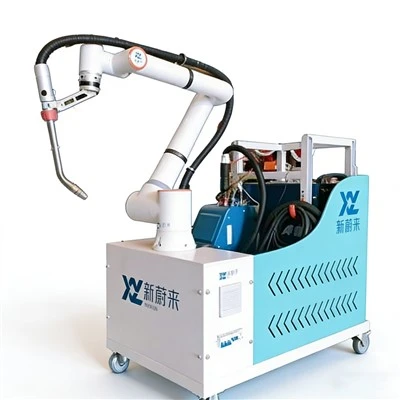

An Industrial Welding Robot has flexible movement capabilities and can move the welding torch along predetermined weld seams according to programmed instructions. Therefore, it can be used for a wide range of workpieces. In practical applications, robotic welding is generally more suitable for workpieces with relatively well-defined structures, stable weld positions, and consistent production requirements. With the proper combination of the robot, welding equipment, fixtures, and positioning devices, different types of workpieces can be welded automatically.
In mechanical manufacturing, an Industrial Welding Robot can be used to weld various mechanical structural components, such as equipment frames, support structures, bases, connecting components, and other assemblies made by joining multiple metal parts. For workpieces with numerous weld seams and repetitive welding operations, the robot can repeatedly perform the same welding movements according to a programmed path, helping maintain consistency throughout the production process.
For sheet metal workpieces, an Industrial Welding Robot can also be used to weld boxes, housings, brackets, metal frames, and similar products. These workpieces generally have relatively regular weld seams. By designing suitable clamping methods, the workpiece can be kept stable during welding, allowing the robot to follow a predetermined welding path accurately.

In the manufacturing of construction machinery and heavy equipment, an Industrial Welding Robot can also be used for welding large brackets, structural components, bases, and connecting parts. For large workpieces, appropriate positioning equipment or positioners can be configured according to actual production requirements, making the welding positions more accessible to the robot.
In addition, industries such as automotive and component manufacturing, metal furniture, storage equipment, agricultural machinery, and electromechanical equipment also have many workpieces suitable for robotic welding. Although these workpieces may differ in size, shape, material, and weld configuration, robotic welding can be considered as long as the welding path can be properly defined and the workpiece can be positioned securely.
It should be noted that not every workpiece is suitable for direct robotic welding. Workpieces with highly variable dimensions, inconsistent weld positions, difficult clamping conditions, or welding locations that are difficult for the robot to reach may require further adjustments to the fixtures, positioning methods, or welding process. For products manufactured in small batches with frequent changes, factors such as changeover frequency and programming time should also be considered.
Therefore, when determining whether a particular workpiece is suitable for an Industrial Welding Robot, it is important to consider factors such as the workpiece structure, weld position, clamping method, production volume, and welding process. With proper selection and configuration, an Industrial Welding Robot can handle a wide range of metal welding applications.