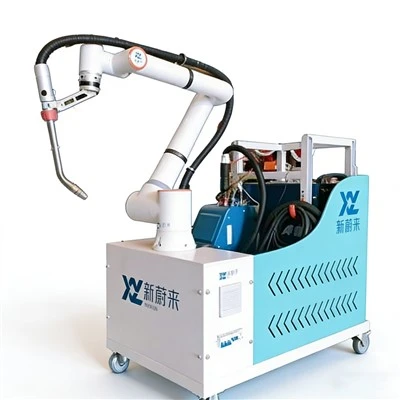

Industrial Welding Robots are mainly used in manufacturing industries that involve a large amount of metal structure welding. They are particularly suitable for production environments where welding tasks are highly repetitive, production volumes are relatively stable, and there are clear requirements for productivity and weld consistency. As manufacturing automation continues to develop, robotic welding has been increasingly applied in automotive manufacturing, construction machinery, metal processing, steel structure fabrication, rail transportation, shipbuilding, agricultural machinery, home appliances, and other machinery manufacturing industries. Industry sources also identify automotive, transportation, shipbuilding, energy, aerospace, and other manufacturing sectors as important application areas for robotic welding and related automation.
In the automotive manufacturing industry, Industrial Welding Robots can be used for welding vehicle body structures, chassis components, and various metal parts. Automotive production typically involves a large number of repetitive welding tasks and places high demands on welding cycle times, positional consistency, and production continuity. Robotic welding can therefore be effectively integrated into automated production lines. Spot welding robots are particularly common in automotive manufacturing, where robotic systems are used to improve welding efficiency and production consistency.
In the construction machinery and agricultural machinery industries, products such as excavators, loaders, lifting equipment, tractors, and other machinery often contain numerous welded metal structures. Some of these products involve long weld seams and repetitive welding operations. Industrial Welding Robots can perform stable and continuous welding tasks, reducing the need for workers to perform repetitive operations for extended periods.
In the steel structure and metal processing industries, Industrial Welding Robots can be used to weld brackets, frames, metal structures, equipment components, and other fabricated products. For products with relatively stable production volumes and consistent workpiece positioning, robots can repeatedly perform welding operations according to predefined welding paths, helping maintain consistency across different production batches.
Rail transportation, shipbuilding, and heavy equipment manufacturing also involve extensive metal structure welding. Some large workpieces may require robots to work together with positioners, linear tracks, or other auxiliary equipment to complete welding operations. Therefore, actual application suitability should be evaluated according to factors such as workpiece size, weld location, production method, and available workspace.
In addition, Industrial Welding Robots can be used in the production of home appliances, metal furniture, storage equipment, construction machinery components, and other metal products. For companies that manufacture a variety of products but still have certain repetitive welding processes, it is possible to evaluate which operations are suitable for robotic automation based on the actual production workflow.
It is important to note that not every welding task necessarily requires an Industrial Welding Robot. For applications involving frequent product changes, unstable workpiece positioning, very small production quantities, or extensive manual adjustments, a more thorough evaluation of the welding process may be necessary before introducing robotic automation. When selecting an Industrial Welding Robot, companies should consider factors such as product type, welding task repetition, production volume, workpiece positioning, welding frequency, and the working environment.
Overall, Industrial Welding Robots are particularly suitable for industries such as automotive manufacturing, construction machinery, steel structure fabrication, metal processing, rail transportation, shipbuilding, agricultural machinery, and other machinery manufacturing sectors. When a production process involves a significant number of repetitive welding tasks and the company aims to improve productivity and maintain consistent welding performance, the suitability of robotic welding can be further evaluated.