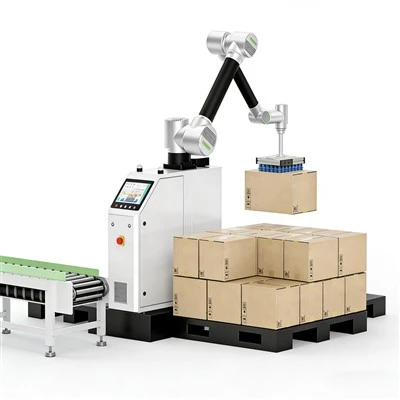
Built for lightweight, universal scene compatibility, the Collaborative Robotic Palletizer features far lower environmental barriers than bulky traditional palletizers, which impose rigid rules on floor space, ambient conditions, and civil works. Requiring no specialized operating environment, it functions reliably in standard working spaces across most small and medium-sized domestic factories, processing workshops, and logistics warehouses. Its versatility and flexibility far outperform conventional palletizing machines, supporting transformation and upgrades for all types of manufacturers.
When it comes to temperature and humidity compatibility, the unit matches standard industrial temperature and humidity ranges and runs stably in room-temperature workshops without custom climate-controlled workspaces. It maintains uninterrupted operation through natural winter cold and summer heat without mechanical stalling, program malfunctions, or sensor failures. It also features strong moisture and anti-condensation performance, suiting slightly humid working areas including food processing, daily chemical, and cold chain surroundings. Humidity fluctuations will not compromise its operating precision or service life; only permanently flooded or heavily submerged areas should be avoided.
In terms of dust and cleanliness standards, the Collaborative Robotic Palletizer does not demand high-grade dust-free or cleanroom environments. It fully accommodates typical industrial settings with minor dust and debris, such as facilities producing construction materials, hardware, animal feed, chemical goods, and packaged food. Core electrical control and sensing components are sealed with dust-proof shielding, blocking airborne workshop dust and material fragments from infiltrating the equipment. This prevents component jamming, circuit breakdowns, and sensor malfunction. Minor daily dust accumulation will not disrupt normal operation or palletizing accuracy, reducing frequent maintenance and suiting rugged industrial working environments.
For floor space and infrastructure needs, the machine removes the cumbersome prerequisites of traditional palletizers: custom poured foundations, fixed steel frames, and isolation fencing. Its solid weight distribution and balanced center of gravity allow direct placement on flat cement or epoxy floors without floor reinforcement, anchor drilling, or factory layout overhauls. Thanks to its compact footprint, it can be flexibly positioned at production line ends, workshop corners, and warehouse transfer zones. It adapts to space-constrained sites including outdated workshops, small factories, and condensed production lines, requiring no facility remodeling from the enterprise.
Additionally, the Collaborative Robotic Palletizer remains unaffected by lighting intensity, typical factory noise, and mild vibration. It will not produce palletizing deviations caused by variable lighting or vibration from adjacent workshop machinery, delivering powerful anti-interference capabilities. The only environments to avoid are extreme harsh conditions: heavily corrosive atmospheres, permanent standing water, strong electromagnetic interference, and ultra-high-dust explosive environments. It operates reliably in almost all standard production and warehousing spaces, enabling low-cost intelligent automation upgrades for manufacturers of all sizes.

 English
- English
- Français
- Deutsch
- 日本語
- Italiano
- Español
- Português
- русский
- 한국어
- Malti
- Čeština
- O'zbek
- Latviešu
- magyar
- Việt Nam
- فارسی
- українська
- Bai Miaowen
- हिंदी
- Norsk
- Srbija jezik (latinica)
- Kreyòl Ayisyen
- עברית
- Ελληνικά
- dansk
- bosanski
- Türkçe
- اردو
- Lietuvių
- slovenščina
- Svenska
- ไทย
- íslenska
- Cymraeg
- Gaeilgenah Éireann
- hrvatski
- slovenčina
- România limbi
- Polski
- عربي
- Català
- Eesti
- Български
- Nederlands
- বাংলা
- Indonesia
- Melayu
- suomi