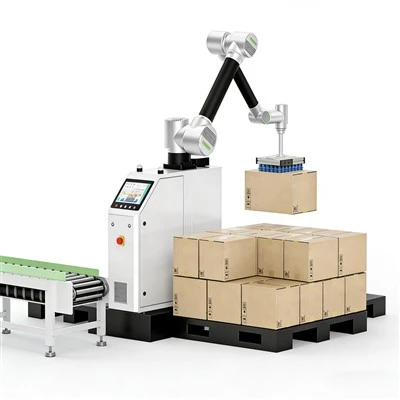


One of the core strengths of the Collaborative Robotic Palletizer is its exceptional operational safety. Unlike conventional industrial palletizers that demand physical fencing and isolated work zones, this unit is engineered for mixed human-machine workshop environments. It establishes a comprehensive safety framework spanning hardware shielding, intelligent perception, operational logic, and body design, which completely resolves the high hazards and limited application scenarios associated with older equipment, suiting continuous production routines in all types of workshops.
In terms of intelligent safety sensing, the machine integrates high-precision vision and tactile sensors to deliver 360° blind-spot-free monitoring. It continuously identifies anomalies including staff movement, material misalignment, and foreign objects entering the working area. Instead of the fixed threshold detection used by traditional machinery, its adaptive safety recognition accurately distinguishes normal material conveyance from unauthorized human entry, avoiding unnecessary shutdowns that reduce production throughput. When personnel enter the critical safety perimeter, the unit lowers its operating speed in advance to maintain soft, stable movement. If workers move closer or make contact with the robotic arm, the palletizer triggers an instant stop to eliminate crushing and collision risks, with millisecond response times and zero protective delay.
For operational safety logic, the Collaborative Robotic Palletizer comes with a dedicated safety control system loaded with multi-layer protective programs featuring self-diagnosis and fault lockout functions. While running, it conducts real-time checks on power, transmission, and braking components. If irregularities such as motor faults, transmission jams, or program errors are detected, the system immediately locks all movement to stop uncontrolled machine travel, robotic arm flailing, or falling goods. Furthermore, palletizing motions are refined via precise algorithms to deliver consistent trajectories and regulated force. Every stage of gripping, lifting, horizontal transfer, and product deposition proceeds smoothly and gently, eliminating hazardous behaviors like abrupt high-speed stops or violent swings to mitigate operational risks at the source.
Regarding physical body protection, the whole machine adopts human-centered safety engineering. All robotic arm edges and outer casings are rounded and deburred, with no sharp corners or protruding structures that could cut or scrape operators upon accidental contact. The robust frame and optimized center of gravity prevent shaking, shifting, or tipping during extended high-volume operation, sustaining stable performance. Moreover, the Collaborative Robotic Palletizer eliminates the need for supplementary safety hardware such as perimeter fences and light curtains. This saves valuable workshop floor space and removes blind visual zones created by barriers, allowing clear sightlines and secure close-range human-machine collaboration.
Overall, the Collaborative Robotic Palletizer's safety safeguards operate throughout every stage of production, balancing reliable protection with operational flexibility. It does not require full-time on-site supervision and is easy for new operators to learn. Ideal for workshops in food, chemical, construction material, logistics and other sectors, it builds a complete safety buffer covering equipment function, personnel protection, and on-site workflows, drastically cutting workplace safety hazards and corporate safety management overheads.