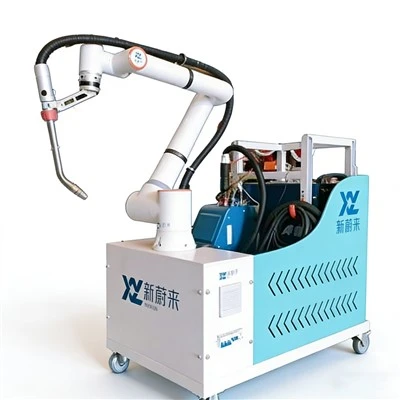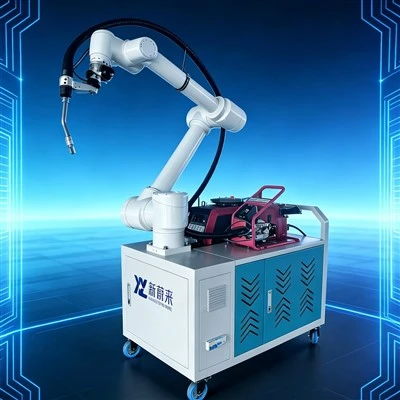


In daily production within industrial welding workshops, equipment noise exerts a critical influence on the working environment, operators' experience and overall workshop operational order. When enterprises select automated welding equipment, noise levels are always a primary concern. Companies seek to avoid overly noisy machinery that worsens workshop conditions, accelerates operator fatigue and obstructs on-site communication. During the R&D phase of the Mobile Collaborative Welding Robot, human-centric workshop requirements were fully considered, with priority given to optimizing noise suppression performance. It delivers excellent noise control and suits continuous routine operation in all types of welding workshops.
Unlike traditional fixed welding equipment and outdated welding manipulators that produce high-frequency roaring and mechanical vibration noise, this robot implements comprehensive noise reduction optimization covering core moving components and the complete frame structure. Key noise sources including drive motors, traveling transmission assemblies and robotic arm motion units are fitted with professional vibration damping and sound insulation fittings. These fittings effectively offset mechanical vibration generated during operation and curb noise generation and propagation at the source. Meanwhile, the frame adopts a closed silent structural design to block minor internal operating noise from spreading outside the working zone.
In practical application, when the robot travels to change positions, adjusts its robotic arm or performs regular welding tasks, the self-generated operating noise remains extremely low and barely constitutes independent noise interference. Under normal workshop working conditions, the main background sound only comes from inherent welding process noise. The robot' s operating noise does not overlap to form a noisy environment. Even under long-term non-stop continuous operation, the robot will not grow louder, produce abnormal rattling or vibrational roaring, maintaining consistently quiet and stable operation.
For operators, the low-noise characteristic significantly enhances working experience. Long hours of monitoring will not trigger tinnitus, irritability or fatigue induced by noise, lowering occupational discomfort caused by noisy surroundings. In addition, a quiet working environment enables smooth communication between operators for real-time progress coordination and plan adjustment. Operators can also clearly distinguish normal operational sounds from abnormal noises to quickly identify potential issues, improving operational safety and standardization.
Furthermore, the silent design of the Mobile Collaborative Welding Robot adapts to multi-station and densely arranged workshop environments. When multiple units operate simultaneously, noise overlap and chaotic workshop noise will not arise. It maintains a neat, orderly and comfortable working environment, meeting the environmental standards of modern smart manufacturing workshops. It is an automated welding device that balances operational efficiency and humane working conditions.