

If you've ever walked through a warehouse at 2 a.m., watching workers lift identical cardboard boxes, heavy plastic jugs, or stacked bags onto pallets for hours on end, you know two things: first, that task is physically grueling, and second, it's exactly the kind of repetitive, high-volume work robots were made to do. Palletizing robots have transformed logistics and manufacturing operations over the past two decades, cutting down on workplace injuries, speeding up order fulfillment, and reducing human error that can come from long shifts of monotonous lifting. As a supplier focused on bringing reliable, adaptable palletizing solutions to businesses of all sizes, I've spent years walking alongside factory managers, line supervisors, and maintenance teams to break down how these machines actually work-because understanding their core components is the first step to deciding if a palletizing robot is the right fit for your operation.
When most people picture a palletizing robot, they think of a big arm swinging back and forth in a box plant, grabbing 12 cases of cereal at a time and stacking them neatly on a wooden pallet. But that arm is just the most visible part of the system. A full palletizing robot setup is a coordinated network of specialized parts, each designed to handle a specific task: moving product, detecting it, storing it in the right order, and communicating with the rest of your facility's software. Let's dive into each of these components, because even the most powerful arm won't work well if one part is missing or mismatched to your needs.
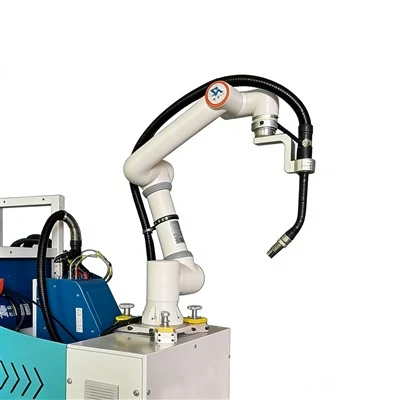
The first and most obvious main component is the robotic manipulator-what most people call the "arm." This isn't a one-size-fits-all part; manipulators come in different sizes, load capacities, and movement ranges to match the products you're palletizing. For smaller operations that handle lighter loads, like retail boxes or small consumer goods, a collaborative palletizing robot makes a lot of sense. Collaborative robots, or cobots, are designed to work safely alongside human workers, no safety cage required, which is perfect for small warehouses or lines that need flexible floor space. If you're managing a mid-sized facility with higher throughput, our CR40 Collaborative Palletizing Robot is built to handle payloads up to 40 kilograms, with a reach that can cover pallets up to 1.8 meters high, enough for most standard industrial pallet sizes. For even heavier loads, like 50-kilogram bags of cement or industrial parts, our CR50 Collaborative Palletizing Robot is built with a higher payload capacity and reinforced joints to handle the extra weight without sacrificing precision. What makes these manipulators different from older industrial robots is their joint design: modern palletizing manipulators use servo motors that allow for six degrees of freedom, meaning they can twist, bend, and rotate to reach tight spots, adjust for irregular package shapes, and stack products in almost any pattern-block, column, interlock, whatever your operation needs.
Next, a critical component that's often overlooked until it malfunctions: the end-of-arm tooling, or EOAT. This is the part of the robot arm that actually touches the product, and choosing the wrong EOAT is one of the most common mistakes we see customers make when setting up their palletizing system. Imagine trying to stack 20-liter water jugs with a gripper designed for flat cardboard boxes-you'd end up with a mess, or worse, a broken product. EOAT comes in several main types, each for a specific product category. Vacuum grippers are the most common for flat, smooth items like boxes, bags, or bottles; they use suction cups to grip and lift the entire package in one move, which is fast and gentle on fragile goods. For irregularly shaped or heavy items, like crates or metal parts, mechanical grippers work better-these have adjustable jaws that close around the product to hold it securely, even if it has an odd shape. Some specialized EOAT we offer for custom applications include coil lifters for steel coils, drum grippers for industrial barrels, and bag placers for loose bulk bags. The key here is that EOAT needs to be matched to both the product's weight, shape, and material, as well as the palletizing pattern you're using. A good EOAT will cut cycle times by 20% or more, because it's designed to pick and place exactly as your line needs, without having to adjust multiple settings mid-task.
Third, the robot controller is the "brain" of the entire system, and it's where all the programming and coordination happens. If the manipulator is the arm, the controller is the central computer that tells it where to move, how fast to move, and when to pick up or drop a product. The controller stores all of your palletizing patterns, so you can switch between different product SKUs with just a few clicks-no need to reprogram the entire system every time you get a new order. For example, if your line is running cereal boxes one day and snack bars the next, you can pull up the saved pattern for cereal, adjust the EOAT settings, and start running in minutes, rather than spending hours on programming. Modern controllers also have built-in safety features, which are especially important for collaborative systems like the Collaborative Robot Palletizer Systems we design. These features include force-sensing technology that stops the robot immediately if it touches a human or an object in its path, so you don't have to install expensive safety cages around the entire work area. The controller also connects to your facility's other systems-like your conveyor line, barcode scanners, and inventory management software-so it can receive real-time data on which products need to be palletized, how many of each, and where they need to be placed on the pallet. This integration reduces errors, because the robot doesn't have to rely on manual inputs from workers to know what to do next.
Fourth, you can't have a palletizing robot without the supporting infrastructure and peripheral components, which are often the unsung heroes of a successful setup. The most basic of these is the pallet itself, but more specifically, the pallet dispensers and conveyors that feed empty pallets to the robot and remove full ones. Conveyors are critical for moving products from the production line to the robot's work area, and then moving full pallets away to shipping or storage. Without a properly sized conveyor, the robot might not get products fast enough to meet throughput goals, or it might have to wait for empty pallets, slowing down the entire line. Another key peripheral is sensors-like photoelectric sensors that detect when a package is in place for the robot to pick, or height sensors that make sure the pallet is stacked evenly, so it doesn't tip over during transport. For facilities that run 24/7, a pallet stacker that automatically stores empty pallets and removes full ones can reduce manual labor significantly, so workers don't have to manually load and unload pallets all day. The floor also matters: palletizing robots need a level, stable surface, because even a 1-centimeter uneven spot can throw off the robot's precision over time, leading to damaged products or stacked pallets that are off-center.
Now, let's talk about how these components come together in a real-world setup, because understanding individual parts is only half the battle. A few months ago, I worked with a snack food company that was dealing with high turnover in their palletizing department, as well as a 15% error rate in stacked pallets (which meant damaged products and returned orders). They initially thought they just needed a bigger, stronger robot arm, but when we walked through their operation, we realized their EOAT was outdated, and their controller didn't integrate with their existing conveyor system. We recommended a complete system based on the Palletizing Robot solutions we offer, paired with a custom vacuum EOAT for their snack boxes, a controller that connected to their conveyor and inventory software, and light curtains for safety. Within three months, their error rate dropped to less than 1%, their palletizing throughput increased by 30%, and they were able to reassign their manual palletizing workers to higher-skill tasks, reducing turnover by 25%. That's the power of getting all the components right-not just picking a robot arm, but matching every part to your specific operation.
If you're considering adding a palletizing robot to your facility, the first step is to evaluate your needs: what products are you handling? What's your required throughput? Do you need the robot to work around human workers, or in a separate area? Our team can help you navigate these questions, whether you're a small business just starting to automate, or a large manufacturing plant looking to upgrade your existing line. Our range of solutions, from entry-level collaborative robots to high-throughput systems, are designed to adapt to your unique challenges. Whether you're looking for a flexible, cobot-based solution for small spaces like the Collaborative Cobot Palletizer, or a heavy-duty system for high-volume industrial applications, we have the expertise to help you find the right fit.
Ready to take the first step toward reducing labor costs, improving productivity, and making your facility safer for workers? Reach out to our team to discuss your palletizing robot needs, and we'll walk you through every component, customization option, and integration to build a system that works for your operation. You can learn more about our collaborative palletizing solutions on our website, where you'll find detailed specs for our CR40, CR50, and other models, as well as information on complete systems tailored to different industries.
References:


- International Organization for Standardization. (2011). Robots and robotic devices – Safety requirements for industrial robots – Part 1: Requirements. ISO 10218-1:2011.
- Logistics Management Institute. (2022). Collaborative Robotics in Warehousing: Impact on Productivity and Worker Safety. LMI Press.
- Association for Advancing Automation. (2023). Palletizing Robotics Market Report: Global Trends and Application Analysis. A3 Publications.