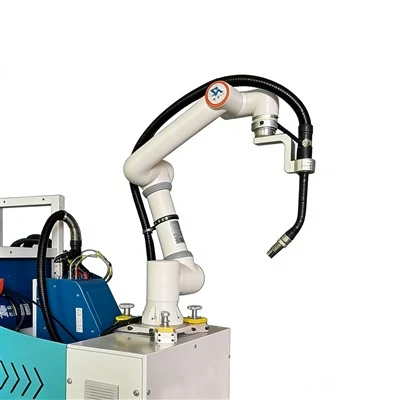


If you've ever spent time on a welding shop floor (or even watched a show about manufacturing), you know how critical speed is-for a line, a race, and yeah, even welding. But here's the thing: I've been selling Mobile Collaborative Welding Robots for a few years now, and one question I get all the time is, "Does how fast the robot moves actually mess up the weld quality?" It's not a random, "it depends" answer-there's actual science behind it, and if you're a fabricator trying to cut costs without burning parts, this matters.
Let's start with the basics. Welding quality isn't just about looking pretty (though pretty welds help with inspection). It's about penetration, fusion, no porosity, and minimal spatter. The robot's movement speed directly controls how long the weld pool is exposed to the heat source-usually MIG, TIG, or plasma for collaborative robots. Too fast, and you don't give the metal enough time to melt properly or for filler metal (if used) to flow into the joint. Too slow, and you overheat the base metal, causing warping, burn-through, or even cracking. It's a tight balance, especially when you're working with a mobile setup vs. a fixed arm-more on that later.
Let's break down speed's impact. First, penetration: that's how deep the weld melts into the base metal, which is non-negotiable for structural parts (think farm equipment, metal frames, or heavy-duty brackets). If a robot moves too quickly, the heat input per unit length drops. For example, if your welding current is 180 amps and voltage is 24V, moving at 10 inches per minute (ipm) vs. 20 ipm means half as much heat is applied to every inch of joint. Thin metal might get away with fast moves, but thick steel? You'll get a shallow, weak weld that'll snap under pressure. I've seen fabricators test this with old parts-too fast, and the weld breaks during a pull test every time.
Then there's fusion: that's when the weld pool melts both base metal pieces so they bond together, not just the filler sitting on top. Slow speed might seem helpful for more heat, but too slow and you can get "over-welding"-the filler puddles too much, doesn't mix with the base metal, and creates brittle joints. Porosity is another big one-tiny gas bubbles that form when the weld cools too fast or there's too much air around. If the robot's moving at the right speed, the gas can escape before the metal solidifies. Too fast, and the metal cools before bubbles get out; too slow, and excess heat might pull air into the joint. Spatter too-no one likes cleaning that off. Fast speed can lead to unstable arc, which makes spatter fly everywhere, while slow speed might let the arc sit in one spot and cause extra spatter or burn-through.
Now, I sell mobile collaborative welding robots, so let's talk about how mobility changes this. Fixed robots are bolted in one spot, so their speed is consistent across a work area. Mobile ones roll on wheels, so their movement can shift a little if the floor isn't perfectly flat, or if the part is uneven. That's why mobile setups need to have calibrated speed controls-if your robot slows down going over a small dip on the shop floor, you might get a burn-through there, while a bump makes it speed up and skip a spot. I once worked with a small fabrication shop that switched from a fixed robot to our Mobile Collaborative Welding Robot and thought "speed is speed"-they didn't recalibrate for the uneven floor, and they had to rework 20% of their parts for a month. Once they adjusted the speed for each section, that dropped to less than 2%.
Wait, not all welding robots are the same, right? We offer different models for different jobs. For example, the 1600 Arm Reach Welding Robot is perfect for larger parts that a fixed arm can't reach, so speed there matters for getting consistent welds across a bigger surface. Our Programmable Collaborative Welding Robot lets you input custom speed per weld path, which is a game-changer for parts with varying joint thickness-like a bracket that's thick in one spot and thin in another. If you just use a one-size speed, you'll mess up both ends. Also, our Magnetic Welding Robot is great for holding parts in place while welding, so the robot's movement doesn't shift mid-job-part stability is tied to speed too, because if the part moves, the robot has to compensate and speed might get off.
Let's get into real-world numbers. A common test we do with customers: thin steel (1/8 inch) for trailers. Optimal speed is 15-18 ipm. Go to 25 ipm, and penetration drops by 30%-the weld won't hold during a load test. Go to 10 ipm, and you get burn-through on the thin metal. For thicker metal (1/4 inch), the sweet spot is 10-12 ipm-slower to get enough penetration without overheating. That's not random; it's from our in-house testing, but also from industry standards from the American Welding Society (AWS), which I always recommend checking because it's not just our sales talk.
Another factor: travel angle. The robot's speed interacts with the angle it's moving at-drag vs. push angle. If you're using a push angle (common for MIG), a slightly slower speed might help with fusion, while a drag angle needs a touch faster speed. But if your robot's speed is off, even the right angle won't fix it. I've had customers ask if they can just set the robot to a "medium" speed and ignore it-no way. Every joint, every part, every material needs a speed adjustment. That's why collaborative robots are better for small-batch jobs, because you can tweak speed for each part, unlike fixed-line robots that are set once for mass production.
What about common mistakes? New robot users often think faster = more parts per hour, so they crank up speed. But if the welds are bad, you're wasting more time reworking or scrapping parts than you saved by going fast. A customer last year told me they were outputting 10 parts an hour with their old robot, but 3 were scrap. They switched to our Welding Collaborative Robot, set the correct speed for each part, got 12 parts an hour, and scrap rate dropped to 2%. That's a win-speed optimization isn't just about moving faster, it's about moving at the right speed.
And with mobile robots, you have to account for setup time, too. If you're moving the robot from one work station to another, you don't want it moving at full speed around the shop-safety first, but also, when it's near a part, it should slow down to weld speed. Our robots have built-in sensors that adjust speed based on distance from the part, which takes the guesswork out. No more worrying if the robot's moving too fast when it gets close to a joint.

Wait, is there a case where faster is better? Maybe for very thin materials or high-speed welding applications, but that's specialized. Most fabricators are working with mid-thickness steel, aluminum, or stainless, and for that, speed consistency is more important than raw speed. A robot that moves at a steady 15 ipm is better than one that zips at 20 ipm for half the weld and crawls at 8 ipm for the other half. That's where programmable robots shine-you can map out the entire weld path, set speed for every inch, so it's consistent.
So, what should you do if you're dealing with welding robot speed? First, test each material and part thickness to find the sweet spot. Use AWS guidelines as a starting point, then tweak with your own parts. If you're using a mobile robot, make sure you calibrate it for your shop floor-uneven surfaces can throw off movement. If you're working on small-batch or custom parts, get a programmable robot so you can adjust speed on the fly. And don't forget part holding-magnetic fixtures can keep parts stable, so the robot's movement doesn't get disrupted, which helps keep speed consistent.
At the end of the day, the robot's movement speed is a core variable that makes or breaks welding quality. It's not something you can set and forget, but with the right robot-like our mobile, programmable, or magnetic models-and a little testing, you can get consistent, high-quality welds without wasting time or materials.
If you're looking to upgrade your welding setup and want to talk about how robot speed can work for your specific parts, reach out. We can help you find the right robot for your shop, whether that's our Mobile Collaborative Welding Robot for flexible floor space, the 1600 Arm Reach Welding Robot for larger parts, or a programmable model for custom jobs.
References:
- American Welding Society. (2022). Guide for the Use of Automation and Robotics in Welding. AWS D16.1/D16.1M:2022.
- Lin, S., & Eager, T. W. (2020). Effects of travel speed on weld bead geometry in gas metal arc welding. Journal of Manufacturing Processes, 56, 452-459.
- International Organization for Standardization. (2019). Robots and robotic devices-Safety requirements for industrial robots-Part 1: Robots. ISO 10218-1:2019.